

What is Cloud-Native Security for E-commerce?
Cloud-native security for e-commerce is a set of practices that embed security into every stage of cloud-based online store development and operation, from code to production. It leverages Zero Trust principles, shift-left security, and specialized protections for microservices, containers, and serverless functions to ensure data protection and compliance.
The Evolution of E-commerce Security: Why Cloud-Native Now?
E-commerce security has evolved dramatically, moving from traditional perimeter defenses to a modern, integrated approach known as **cloud-native security**. Cloud-native security in e-commerce is defined by its inherent integration into the entire development and operational lifecycle of cloud-based online stores. It leverages principles like Zero Trust and Shift-Left, focusing on protecting dynamic, distributed architectures such as microservices, containers, and serverless functions, rather than relying on perimeter-based defenses. This approach ensures security is built-in from concept to deployment, safeguarding sensitive customer data and transactional integrity within the agility of cloud environments. For businesses, especially newcomers in the web world and those seeking secure, scalable digital solutions, embracing cloud-native security is no longer optional but essential by 2026.
Brief History of E-commerce Security Challenges
Early e-commerce platforms often relied on monolithic architectures and legacy security systems. These systems were primarily designed around network perimeters. However, this approach struggled to protect against sophisticated data breaches and internal threats. The focus was often on reacting to incidents rather than preventing them, leading to significant vulnerabilities.
Introduction to Cloud Computing and its Benefits for E-commerce
Cloud computing transformed the digital landscape, offering scalability, flexibility, and cost efficiency. For e-commerce, it meant the ability to handle fluctuating traffic, rapidly deploy new features, and expand globally without massive upfront infrastructure investments. Cloud providers offer robust foundational security, but securing applications within the cloud remains the user’s responsibility.
Defining Cloud-Native and its Implications for Security
**Cloud-native security** is an approach that integrates security directly into cloud applications, infrastructure, and development processes, leveraging cloud services and architectures to protect distributed environments. It embraces the dynamic, distributed nature of modern applications built with microservices, containers, and serverless functions. This means security is no longer an add-on; it’s a core component of the entire development and operational lifecycle.
Why Traditional Security Models Fall Short in a Cloud-Native Environment
Traditional, perimeter-based security models are ill-suited for cloud-native architectures. These older models assume a clear “inside” and “outside” of a network. Cloud-native environments, however, are highly distributed, with microservices communicating across various network segments. Perimeter defenses cannot adequately protect individual services or serverless functions, leaving many attack vectors open.
The Urgency for E-commerce Businesses to Adopt Cloud-Native Security by 2026
The digital threat landscape is evolving rapidly. As of 2026, e-commerce businesses face increased pressure from advanced persistent threats, stricter compliance regulations, and the need for continuous availability. Adopting cloud-native security ensures that online stores are resilient, compliant, and capable of protecting customer data effectively. This proactive shift is crucial for long-term success and customer trust.
Key Principles of Cloud-Native Security for E-commerce
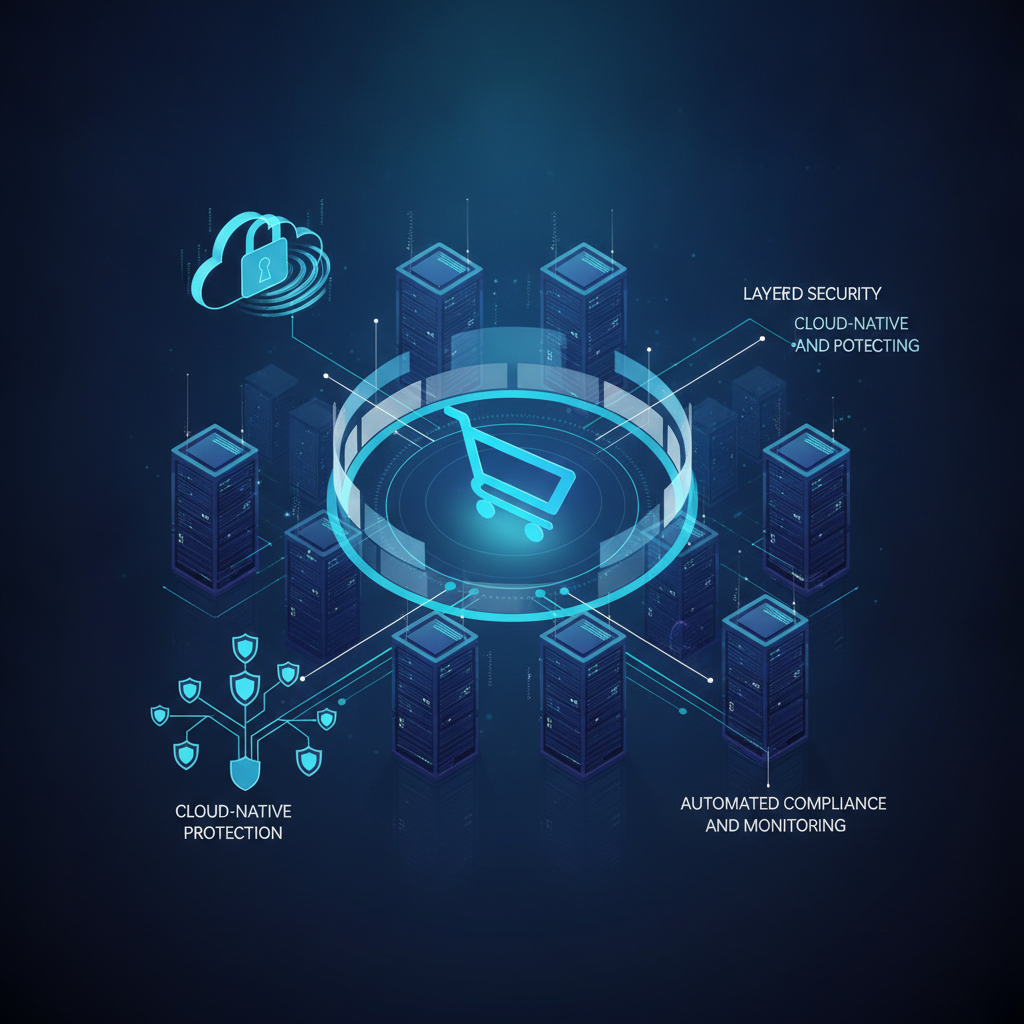
A robust cloud-native security strategy for online stores encompasses several core components: a Zero Trust Architecture for identity-centric security; Shift-Left Security to embed security early in development; specialized security for microservices, containers (Docker, Kubernetes), and serverless functions; comprehensive Identity and Access Management (IAM); Web Application Firewalls (WAF) and API Gateways; continuous security monitoring and incident response; strong data encryption at rest and in transit; and automated security testing (SAST, DAST, SCA) integrated into CI/CD pipelines. These principles form the bedrock of a secure e-commerce platform.
The Four C’s of Cloud-Native Security for Online Stores
The Four C’s of cloud-native security—Cloud, Clusters, Containers, and Code—provide a layered defense model for e-commerce platforms. Each layer addresses specific risks: Cloud refers to the underlying infrastructure security (e.g., AWS, Azure, GCP), including IAM and network policies; Clusters secure the Kubernetes or orchestration layer with role-based access and pod security; Containers focus on scanning Docker images for vulnerabilities and runtime protection; and Code ensures secure coding practices, such as input validation for checkout logic and dependency checks. For example, scanning container images prevents known exploits from reaching production, while adhering to secure coding standards protects payment processing flows.
Zero Trust Architecture
Zero Trust Architecture is a security model that assumes no user or device is trusted by default, requiring continuous verification for every access request. For e-commerce, this ensures that even internal traffic is scrutinized, protecting sensitive customer data and transactional integrity.
- Continuous verification of admin access to order databases and payment gateways.
- Micro-segmentation of customer account services to limit lateral movement during a breach.
- Least-privilege access policies for third-party payment integrations and API calls.
- Real-time authentication and authorization for every API request between storefront and inventory systems.
Shift-Left Security
Shift-Left Security integrates security early into the software development lifecycle, from design to coding. 360Locker champions this with its “security-first build” philosophy, embedding cybersecurity from concept to deployment, ensuring vulnerabilities are caught before reaching production.
- Automated SAST scanning during code commits for checkout and payment modules.
- Threat modeling for new features like wishlists, loyalty programs, or personalized recommendations.
- Developer training on secure coding practices tailored to e-commerce platforms.
- Integrating dependency checks (SCA) into CI/CD pipelines to flag vulnerabilities in open-source libraries.
Microservices Security
Microservices Security protects individual, independently deployable services in an e-commerce architecture, ensuring secure communication and isolation to prevent a single compromise from cascading.
- Implementing mutual TLS (mTLS) for encrypted service-to-service communication, especially between checkout and payment services.
- Enforcing API gateway security for user-facing services like product search, cart, and user profiles.
- Segregating payment processing from catalog browsing services to reduce attack surface.
- Utilizing runtime application self-protection (RASP) to detect and block fraud attempts in real time.
Container Security
Container Security safeguards Docker images and Kubernetes environments by scanning for vulnerabilities and enforcing runtime policies, critical for e-commerce deployments that rely on containerized microservices.
- Scanning images for CVEs before deployment to production Kubernetes clusters.
- Enforcing non-root user privileges and read-only file systems for containers handling sensitive data.
- Applying network policies to isolate payment processing containers from public-facing web containers.
- Regularly updating base images and dependencies to patch known exploits.
Serverless Security
Serverless Security focuses on protecting functions and event-driven architectures, where developers secure code and configurations, as cloud providers only manage the underlying infrastructure.
- Validating all inputs in serverless functions handling order confirmations and coupon validations.
- Storing secrets (API keys, database credentials) in dedicated cloud-native secret stores like AWS Secrets Manager.
- Assigning least-privilege IAM roles to each function to minimize blast radius.
- Monitoring function invocations for anomalies, such as sudden spikes that may indicate abuse.
Threat Landscape and Challenges for E-commerce in 2026
By 2026, e-commerce security threats will evolve to become more sophisticated and targeted, moving beyond simple attacks to include advanced persistent threats (APTs) focused on data exfiltration, highly convincing phishing and social engineering campaigns, and complex supply chain attacks exploiting vulnerabilities in third-party cloud services. Additionally, distributed denial-of-service (DDoS) attacks will continue to pose significant risks to availability, demanding robust 99.95% uptime emphasis, while compliance challenges like PCI DSS, GDPR, and CCPA will intensify globally.
Advanced Persistent Threats (APTs) Targeting Customer Data
APTs are long-term, targeted attacks designed to gain continuous access to a network and steal data. For e-commerce, APTs pose a significant risk, aiming to exfiltrate sensitive customer information like credit card numbers and personal identifiable information (PII). These threats are difficult to detect as they often mimic legitimate network traffic.
Sophisticated Phishing and Social Engineering Attacks
Phishing and social engineering attacks continue to evolve, becoming increasingly convincing. Attackers craft highly personalized emails and messages to trick employees or customers into revealing credentials or installing malware. This can lead to account takeovers or breaches of internal systems, impacting both data security and customer trust.
Supply Chain Attacks in Cloud Environments
Cloud-native applications often rely on numerous third-party libraries, open-source components, and cloud services. Supply chain attacks exploit vulnerabilities in these dependencies. A compromise in one component can ripple through the entire e-commerce platform, affecting thousands of businesses. According to a 2023 report by the European Union Agency for Cybersecurity (ENISA), supply chain attacks are projected to rise by 4x by 2026.
DDoS Attacks and Their Impact on E-commerce Availability
Distributed Denial of Service (DDoS) attacks overwhelm e-commerce websites with malicious traffic, making them unavailable to legitimate customers. For online stores, downtime directly translates to lost revenue and damaged reputation. A key measure of reliability is uptime, and providers like 360Locker emphasize 99.95% uptime hosting to ensure continuous service even under duress.
Compliance and Regulatory Challenges (PCI DSS, GDPR, CCPA) in a Global Context
E-commerce businesses operate globally, facing a complex web of regulations like PCI DSS for payment card data, GDPR for European Union citizen data, and CCPA for California residents. Non-compliance can lead to hefty fines and legal repercussions. Cloud-native security helps meet these requirements through robust data protection and access controls.
Implementing Cloud-Native Security Solutions for E-commerce
Implementing cloud-native security requires a multifaceted approach, integrating various tools and strategies throughout the development and operational lifecycle. This includes a strong focus on identity, network protection, continuous monitoring, and data encryption. Proactive security testing is also essential.
Identity and Access Management (IAM) for Customers and Administrators
Robust IAM is fundamental for e-commerce. It controls who can access what resources and under what conditions. For customers, IAM ensures secure login and personalized experiences. For administrators and developers, it enforces least privilege access, minimizing the blast radius of any potential compromise.
Web Application Firewalls (WAF) and API Gateways
Web Application Firewalls (WAFs) protect e-commerce websites from common web-based attacks like SQL injection and cross-site scripting (XSS). API Gateways manage and secure API traffic, which is critical for microservices-based e-commerce platforms. They provide authentication, authorization, rate limiting, and traffic routing.
Continuous Security Monitoring and Incident Response
Effective cloud-native security requires constant vigilance. Continuous security monitoring involves collecting logs and metrics from all cloud resources, applications, and security tools. An efficient incident response plan ensures that any detected threats are addressed quickly, minimizing their impact.
Data Encryption at Rest and in Transit
Protecting sensitive customer data is paramount. Data encryption at rest scrambles data stored on servers and databases. Data encryption in transit secures data as it moves between systems, such as during online transactions. This dual approach provides comprehensive data protection.
Automated Security Testing (SAST, DAST, SCA) in CI/CD Pipelines
E-commerce businesses can integrate security from the very beginning of their development process by adopting a ‘Shift-Left’ approach. This involves leveraging automated security testing tools within Continuous Integration/Continuous Delivery (CI/CD) pipelines. Static Application Security Testing (SAST) analyzes code for vulnerabilities before deployment. Dynamic Application Security Testing (DAST) tests running applications for weaknesses. Software Composition Analysis (SCA) identifies vulnerabilities in third-party and open-source components.
360Locker’s Approach to Secure E-commerce Platforms

360Locker provides secure, scalable digital solutions for e-commerce, built on a “security-first build” philosophy. Our 360-degree security framework integrates cybersecurity from concept to deployment across all our services. We emphasize creative engineering, 24/7 support, and affordable pricing to serve both newcomers and established businesses.
How 360Locker’s ‘Security-First Build’ Aligns with Cloud-Native Principles
360Locker’s ‘security-first build’ perfectly aligns with cloud-native principles by embedding security into every stage of the development process. From initial design to final deployment and ongoing maintenance, cybersecurity considerations are paramount. This proactive integration minimizes vulnerabilities from the outset.
Our 360-Degree Security Framework for E-commerce
Our unique 360-degree security framework ensures comprehensive protection. This means we consider all potential attack vectors and implement layers of defense across infrastructure, applications, and data. This holistic approach covers everything from secure coding practices to robust network configurations.
Integration of Security Across Website Development, App Development, and Hosting
360Locker integrates security seamlessly across all our service offerings. Whether it’s website development, Android and iOS app development, or hosting services with 99.95% uptime, security is a core component. This ensures a consistent and high level of protection for all digital assets.
Unique Value Propositions: Creative Engineering, 24/7 Support, Affordable Pricing
Our unique value propositions differentiate us. We combine creative engineering with advanced security practices to build innovative yet secure platforms. Clients benefit from 24/7 support, ensuring immediate assistance for any security concerns. Furthermore, our affordable pricing makes top-tier security accessible to a wider range of businesses.
Serving Newcomers and Businesses Seeking Secure, Scalable Digital Solutions
Founded on January 1, 2020, 360Locker serves a diverse clientele, including newcomers in the web world and businesses seeking secure, scalable digital solutions, including e-commerce platforms. We have successfully served over 500 clients, delivering more than 120 projects with an average delivery time of 30-60 days. Our expertise ensures that even businesses new to the digital space receive enterprise-grade security.
The Future: AI, Automation, and Proactive Defense
In the future of e-commerce cloud-native security, AI and automation will play a transformative role by enhancing threat detection and response capabilities. AI and Machine Learning can analyze vast amounts of security data to identify anomalous patterns indicative of advanced threats, while automation can orchestrate faster remediation, reduce human error in security operations, and enforce consistent security policies. This leads to more predictive security analytics, improved cyber resilience, and the ability to proactively defend against emerging threats, including future-proofing against challenges like quantum computing.
Role of AI and Machine Learning in Threat Detection and Response
AI and Machine Learning (ML) are becoming indispensable for cloud-native security. They can analyze vast datasets from logs, network traffic, and user behavior to detect anomalies and identify emerging threats faster than human analysts. AI-powered tools can significantly reduce false positives, allowing security teams to focus on real dangers.
Security Automation for Faster Remediation and Reduced Human Error
Automation in security workflows accelerates incident response and reduces the potential for human error. Automated scripts can isolate compromised systems, apply patches, or block malicious IP addresses instantly. This capability is vital for maintaining the 99.95% uptime commitment critical for e-commerce.
Predictive Security Analytics
Beyond reacting to threats, the future of security involves predictive analytics. By leveraging historical data and AI, security systems can forecast potential attack vectors and vulnerabilities. This allows businesses to implement preventative measures before an attack even occurs, enhancing proactive defense.
The Increasing Importance of Cyber Resilience
Cyber resilience is the ability of an organization to prepare for, respond to, and recover from cyberattacks. It goes beyond mere prevention, focusing on minimizing disruption and ensuring business continuity. For e-commerce, this means quickly restoring services and data after a breach, maintaining customer trust.
Preparing for Quantum Computing Threats (Future-Proofing)
Looking further ahead, quantum computing poses a potential threat to current encryption standards. While practical quantum computers are still emerging, proactive planning for “quantum-safe” cryptography is essential. This future-proofing ensures long-term data security for sensitive e-commerce transactions.
Choosing the Right Partner for Your E-commerce Security
Selecting a cybersecurity partner is a critical decision for any e-commerce business. An experienced partner offers integrated services, dedicated support, and a proven track record. This ensures a comprehensive and reliable security posture.
Criteria for Selecting a Cybersecurity Partner
When choosing a partner, consider their expertise in cloud-native security, their commitment to a “security-first build,” and their ability to integrate security across all digital services. Look for transparent pricing, clear service level agreements, and responsive support. Expertise and experience are paramount.
Why Experience Matters (500+ Clients, 120+ Projects Since Jan 1, 2020)
Experience is a crucial indicator of reliability and capability. Since its founding on January 1, 2020, 360Locker has successfully served over 500 clients and delivered more than 120 projects. This extensive experience demonstrates our ability to handle diverse e-commerce security challenges effectively.
The Benefits of Integrated Services (Development, Marketing, SEO, Hosting)
Choosing a partner like 360Locker that offers integrated services – website development, app development, digital marketing, SEO, and hosting – simplifies security management. A unified provider ensures that security is consistently applied across all aspects of your digital presence, preventing gaps. Our sister concern, ITpreneurs.Tech, further extends this integrated approach.
The Value of Dedicated Support and Free Website Migration
Dedicated 24/7 support is invaluable, especially for e-commerce, where downtime means lost revenue. A partner offering continuous support ensures immediate resolution of security incidents. Additionally, services like free website migration ease the transition to a more secure platform.
Introduction to 360Locker and its Sister Concern ITpreneurs.Tech as a Trusted Provider
360Locker is a trusted provider of secure, scalable digital solutions, emphasizing a “security-first build” for e-commerce and other online ventures. Our commitment to 360-degree security, creative engineering, and customer support, backed by our extensive client portfolio and 99.95% uptime hosting, makes us an ideal choice. Together with our sister concern, ITpreneurs.Tech, we deliver comprehensive and affordable cybersecurity solutions for the evolving digital landscape.
Key takeaways
- Cloud-native security is essential for e-commerce due to the limitations of traditional security models in dynamic cloud environments.
- Core principles include Zero Trust, Shift-Left Security, and specialized protection for microservices, containers, and serverless architectures.
- By 2026, e-commerce faces evolving threats like APTs, sophisticated phishing, supply chain attacks, and critical DDoS vulnerabilities.
- Implementing robust cloud-native security involves IAM, WAFs, continuous monitoring, data encryption, and automated security testing.
- AI and automation are pivotal for future e-commerce security, enabling proactive defense, faster threat detection, and improved cyber resilience.
Frequently Asked Questions
What defines cloud-native security in the context of e-commerce?
Cloud-native security in e-commerce is characterized by its integration into every stage of the software development lifecycle, leveraging cloud services and architectures like microservices and containers, and adopting principles such as Zero Trust and Shift-Left security to protect online transactions and customer data.
How will e-commerce security threats evolve by 2026?
By 2026, e-commerce security threats will become more sophisticated, including advanced persistent threats (APTs) targeting customer data, complex phishing and social engineering attacks, supply chain vulnerabilities within cloud environments, and highly disruptive DDoS attacks impacting availability, alongside growing compliance challenges.
What are the core components of a robust cloud-native security strategy for online stores?
A robust cloud-native security strategy for online stores encompasses Zero Trust Architecture, Shift-Left security, specialized microservices and container security, Identity and Access Management (IAM), Web Application Firewalls (WAF), continuous security monitoring, data encryption, and automated security testing within CI/CD pipelines.
How can e-commerce businesses integrate security from the very beginning of their development process?
E-commerce businesses can integrate security from the outset through a 'Shift-Left' approach, embedding security considerations and testing into the design and development phases, utilizing practices like security-first builds, automated security testing (SAST, DAST, SCA) in CI/CD pipelines, and ensuring security is a foundational element, not an afterthought.
What role do AI and automation play in the future of e-commerce cloud-native security?
AI and automation will be critical for the future of e-commerce cloud-native security by enabling advanced threat detection and response, automating security tasks for faster remediation and reduced human error, providing predictive security analytics, and enhancing overall cyber resilience against evolving threats.
Why is a 'security-first build' critical for e-commerce platforms today and in the future?
A 'security-first build' is critical for e-commerce platforms because it proactively embeds security into every stage of development, significantly reducing vulnerabilities from the outset, ensuring compliance, protecting sensitive customer data, maintaining uptime, and building customer trust, which are all paramount for long-term business success.