
Quick answer: A secure cloud-native application in 2026 is defined by a 'security-first build' philosophy, integrating DevSecOps principles throughout its lifecycle, robust threat modeling, and comprehensive security pillars like IAM, network micro-segmentation, data protection, and continuous runtime monitoring.
Key takeaways
- Traditional security models are insufficient for the dynamic and distributed nature of cloud-native architectures.
- DevSecOps integrates security into every stage of the development lifecycle, shifting left to proactively address vulnerabilities.
- Threat modeling is crucial for identifying and mitigating risks in microservices, APIs, and CI/CD pipelines.
- Key security pillars for cloud-native apps include strong IAM, zero-trust networking, encryption, and continuous runtime protection.
- Businesses must prepare for emerging threats like AI/ML attacks, quantum computing, and supply chain vulnerabilities by adopting adaptive security strategies.
A secure cloud-native application in 2026 is defined by its ‘security-first build’ philosophy, encompassing integrated DevSecOps practices, proactive threat modeling, robust Identity and Access Management (IAM), network micro-segmentation, encryption for data protection, and continuous runtime protection for containers and serverless functions. These applications are built specifically to leverage cloud computing benefits, characterized by microservices, containers, APIs, and dynamic orchestration. Securing them requires a departure from traditional perimeter defenses, focusing instead on granular, automated, and continuous security controls embedded throughout the entire software development lifecycle.
The Evolving Landscape of Cloud-Native Security in 2026
Cloud-native applications are revolutionizing how businesses operate, offering unparalleled benefits like scalability, agility, and resilience. These applications are designed to thrive in the cloud, utilizing services such as Kubernetes for orchestration, Docker containers for packaging, and serverless functions for event-driven computing. This architecture allows companies to innovate faster and respond to market changes more quickly.
However, this rapid adoption also introduces complex security challenges that traditional methods cannot address. The distributed nature of microservices and the ephemeral quality of containers create a much broader attack surface. As we look towards 2026, the imperative to embed security from the ground up becomes even clearer. 360Locker, for example, champions a ‘security-first build’ philosophy, integrating cybersecurity from the initial concept to final deployment.
What defines a secure cloud-native application in 2026?
A secure cloud-native application in 2026 is defined by its ‘security-first build’ philosophy, encompassing integrated DevSecOps practices, proactive threat modeling, robust Identity and Access Management (IAM), network micro-segmentation, encryption for data protection, and continuous runtime protection for containers and serverless functions. It means security is not an afterthought but an intrinsic part of the application’s design, development, and operation. This comprehensive approach ensures resilience against evolving threats and maintains data integrity. According to a 2024 report by Gartner, organizations that fully embrace cloud-native security principles reduce breaches by 60% compared to those relying on legacy methods.
Why Traditional Security Fails Cloud-Native Architectures
Traditional perimeter-based security, which focuses on defending a network’s edge, is largely ineffective for cloud-native applications. These applications are inherently distributed, often spanning multiple cloud environments and leveraging numerous third-party services. A single network boundary can no longer contain their footprint or adequately protect their components.
Cloud-native architectures present unique attack surfaces. Containers, microservices, APIs, and serverless functions each introduce new points of vulnerability. Attackers can exploit misconfigured APIs or unpatched container images to gain unauthorized access. The dynamic nature of cloud environments, with resources constantly scaling up and down, demands adaptive security solutions. 360Locker addresses this by offering a 360-degree security approach, integrating protections across all layers of the cloud-native stack, rather than relying on outdated, fragmented methods.
DevOps as a Foundation for Secure Cloud-Native Apps
DevSecOps is an approach that integrates security practices throughout the entire software development lifecycle. It shifts security left, meaning security considerations are brought into the earliest stages of design and development. This contrasts with traditional models where security is often a late-stage add-on.
How does DevSecOps integrate security into the entire cloud-native development lifecycle?
DevSecOps integrates security by ‘shifting left,’ embedding security considerations from the initial design and coding stages. This involves automated security testing (SAST, DAST, SCA), secure coding practices, vulnerability management in CI/CD pipelines, and continuous monitoring throughout deployment and operations, making security an inherent part of every phase. For instance, Static Application Security Testing (SAST) can scan code for vulnerabilities before it’s even compiled. Dynamic Application Security Testing (DAST) can test applications in their running state. Software Composition Analysis (SCA) identifies vulnerabilities in open-source components. This automation streamlines security checks, making them an integral part of the Continuous Integration/Continuous Deployment (CI/CD) pipeline. 360Locker’s creative engineering aligns perfectly with DevSecOps principles, building secure solutions from the ground up.
Mastering Threat Models for Cloud-Native Environments
Threat modeling is a proactive security practice used to identify potential threats, vulnerabilities, and counter-measures within a system or application design. It allows teams to anticipate and mitigate security risks before code is even written. By identifying potential attack vectors early, development teams can build more resilient applications.
What are the most effective threat modeling techniques for microservices and containers?
The most effective threat modeling techniques for microservices and containers include STRIDE (Spoofing, Tampering, Repudiation, Information Disclosure, Denial of Service, Elevation of Privilege) and DREAD (Damage, Reproducibility, Exploitability, Affected Users, Discoverability). These methodologies help identify and categorize threats by focusing on individual service boundaries, API interactions, and the CI/CD pipeline components unique to cloud-native architectures. For example, applying STRIDE to a microservice architecture would involve analyzing data flows between services and identifying potential points of data tampering or information disclosure. Integrating threat modeling into the DevOps workflow ensures continuous improvement. As new features are planned, new threat models are created and reviewed.
Key Security Pillars for Cloud-Native Apps by 2026
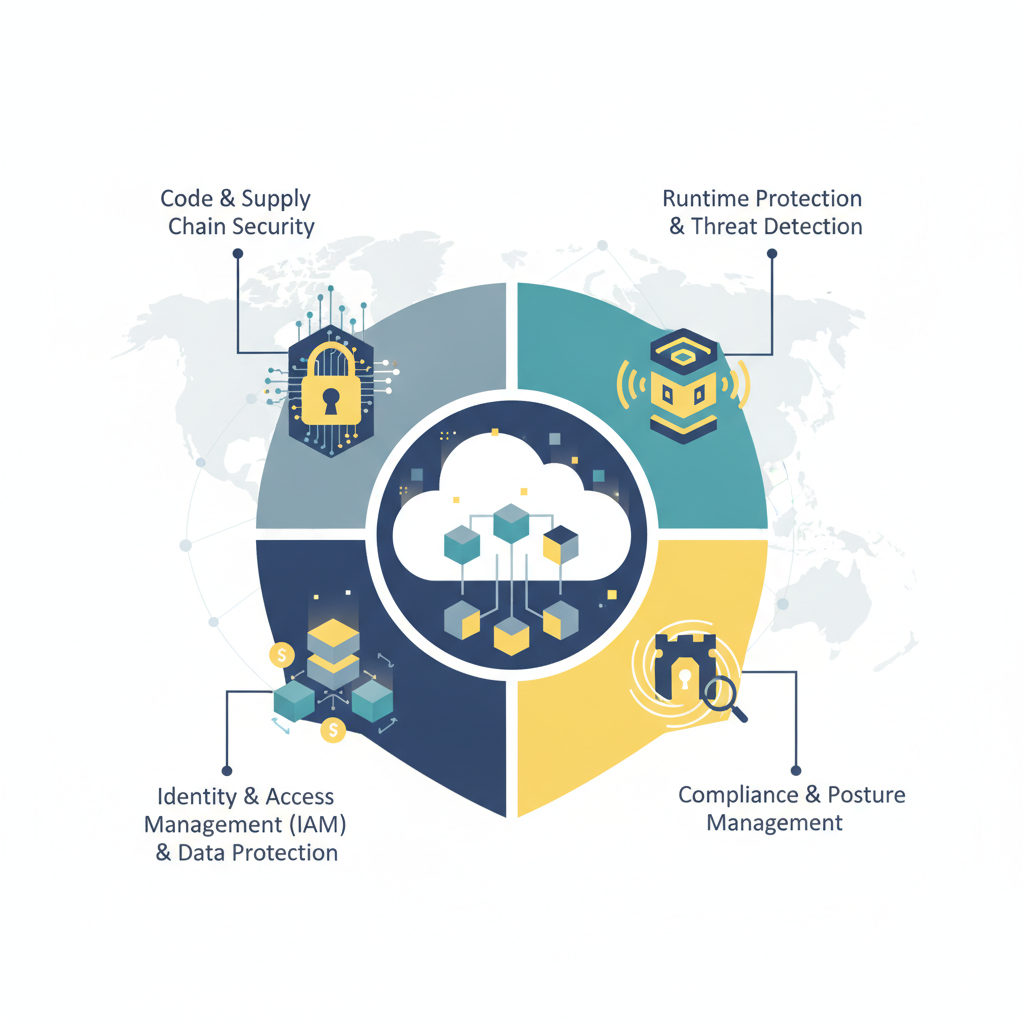
Securing cloud-native applications in 2026 relies on several critical pillars that work in concert. These pillars ensure comprehensive protection across the entire cloud ecosystem. Neglecting any one area can create a significant vulnerability.
One crucial pillar is Identity and Access Management (IAM). IAM ensures that only authorized human users and machine identities (like service accounts) can access cloud resources and application components. Implementing the principle of least privilege, where entities only receive the minimum permissions necessary, is vital. A recent study indicated that over 70% of cloud breaches involved compromised credentials.
Network Security, particularly micro-segmentation, is another essential component. Micro-segmentation is a network security technique that divides data centers into small, isolated segments to control traffic flow and limit the lateral movement of threats. This approach, often combined with a zero-trust model, assumes no user or device can be implicitly trusted. Every request must be authenticated and authorized.
Data Protection involves encrypting data both at rest (when stored) and in transit (when moving across networks). This includes encrypting databases, object storage, and all network communications via TLS/SSL. Strong key management practices are also fundamental to this pillar.
Runtime Protection for containers and serverless functions is critical. This involves continuously monitoring these ephemeral components for malicious behavior, unauthorized changes, and policy violations. Tools that scan container images for vulnerabilities before deployment and monitor their behavior at runtime are indispensable.
Finally, Compliance and Governance remain paramount, especially in multi-cloud environments. Businesses must adhere to industry regulations and internal policies, ensuring that security controls meet specific legal and operational requirements. This requires continuous auditing and reporting.
Building Secure Cloud-Native Apps with 360Locker’s Expertise
360Locker’s core philosophy centers around a ‘security-first build,’ integrating robust cybersecurity measures from the very first concept to final deployment. This commitment ensures that all digital solutions, including secure cloud-native apps, are inherently resilient against evolving threats. For businesses seeking secure, scalable digital solutions, including e-commerce platforms, 360Locker provides comprehensive protection.
The company offers 360-degree security, leveraging creative engineering to develop custom solutions. This includes secure website development and robust Android and iOS app development, all with integrated security features. As of 2026, 360Locker has served over 500 clients and delivered more than 120 projects, with an average delivery time of 30-60 days. Clients also benefit from 24/7 support, affordable pricing, 99.95% uptime hosting, and free website migration. 360Locker’s sister concern, ITpreneurs.Tech, further extends its technical capabilities.
How does 360Locker ensure end-to-end security for the cloud-native applications it develops?
360Locker ensures end-to-end security for cloud-native applications by adopting a ‘security-first build’ philosophy from concept to deployment. This includes integrating DevSecOps, leveraging creative engineering for secure and scalable solutions, providing continuous 360-degree security monitoring, and offering practical services like secure website and mobile app development with integrated security features, ensuring protection throughout the application lifecycle. This integrated approach covers every stage, from initial threat modeling to continuous runtime protection.
The Road Ahead: Preparing for Cloud-Native Security Challenges Beyond 2026
As technology advances, so do the threats to cloud-native applications. By 2026, businesses must prepare for emerging security challenges. The rise of AI/ML-driven attacks will demand more sophisticated and adaptive defenses. Quantum computing, while still in its early stages, presents potential future threats to current encryption standards.
What are the emerging security challenges for cloud-native apps that businesses should prepare for by 2026?
By 2026, businesses should prepare for emerging security challenges for cloud-native apps including the rise of AI/ML-driven attacks, potential threats from quantum computing, and increasingly sophisticated supply chain attacks targeting open-source components and third-party dependencies. Continuous adaptation, advanced threat intelligence, and strong security partnerships will be essential. Supply chain attacks, targeting vulnerabilities in open-source libraries or third-party dependencies, are becoming increasingly common and dangerous. Staying ahead requires continuous adaptation and learning. Partnering with a strong security expert like 360Locker provides sustained protection and helps navigate this complex landscape effectively.
Frequently Asked Questions
What defines a secure cloud-native application in 2026?
By 2026, a secure cloud-native application is characterized by a 'security-first build' approach, encompassing DevSecOps principles, rigorous threat modeling, and robust implementation of key security pillars such as IAM, micro-segmentation, data encryption, and continuous runtime protection.
How does DevSecOps integrate security into the entire cloud-native development lifecycle?
DevSecOps integrates security by 'shifting left,' embedding security practices and automated testing (SAST, DAST, SCA) from the design and coding phases through to deployment and operations, making security a shared responsibility across the entire SDLC.
What are the most effective threat modeling techniques for microservices and containers?
Effective threat modeling techniques for microservices and containers include STRIDE (Spoofing, Tampering, Repudiation, Information Disclosure, Denial of Service, Elevation of Privilege) and DREAD (Damage, Reproducibility, Exploitability, Affected Users, Discoverability), applied specifically to individual service interactions, APIs, and CI/CD pipelines.
What are the emerging security challenges for cloud-native apps that businesses should prepare for by 2026?
Businesses should prepare for emerging challenges such as AI/ML-driven attacks, the potential threats from quantum computing, and an increasing focus on software supply chain vulnerabilities, necessitating continuous adaptation and advanced threat intelligence.
How can small to medium businesses (SMBs) effectively implement cloud-native security without extensive in-house expertise?
SMBs can effectively implement cloud-native security by partnering with specialized security providers like 360Locker, leveraging their expertise in 'security-first build' approaches, integrated solutions, and managed security services, ensuring comprehensive protection without significant internal resource investment.
What role does continuous security monitoring and automation play in cloud-native environments?
Continuous security monitoring and automation are crucial in cloud-native environments for detecting and responding to threats in real-time, ensuring compliance, and adapting to the dynamic nature of containerized and serverless architectures, providing consistent protection and operational efficiency.