

Quick answer: Edge computing revolutionizes e-commerce by processing data closer to the customer, significantly reducing latency for faster experiences, bolstering security through distributed models, and enabling advanced real-time applications like AR/VR shopping and personalized content.
Key takeaways
- Edge computing processes data locally, drastically cutting latency and improving e-commerce speed and user experience.
- It enhances security by distributing data processing, reducing centralized points of failure, and enabling faster threat detection.
- Edge computing facilitates real-time personalization, immersive AR/VR shopping, and optimized logistics for future e-commerce.
- A 'security-first build' approach is crucial for implementing edge computing, integrating security from initial planning through deployment.
- Businesses like 360Locker offer expertise in secure web development and hosting, aligning with the needs of scalable, future-ready edge e-commerce platforms.
The Evolving Landscape of E-commerce: Why Speed & Security Matter More Than Ever
The e-commerce landscape in 2026 is defined by an insatiable demand for instant gratification and robust security, pushing traditional cloud computing architectures to their limits. Shoppers expect websites to load in milliseconds and transactions to complete instantly, while concerns over data breaches and privacy violations are at an all-time high. Businesses face constant pressure to deliver seamless, personalized experiences while safeguarding sensitive customer information. This evolving environment highlights the critical need for advanced solutions like **edge computing e-commerce** to overcome challenges such as slow load times, data breach vulnerabilities, and suboptimal user experiences.
The current e-commerce environment presents several significant challenges. Websites often suffer from high load times, leading to abandoned carts and frustrated customers. Data breaches are a persistent threat, eroding customer trust and incurring substantial financial and reputational costs. User expectations for instant, personalized experiences continue to rise, demanding real-time data processing that traditional centralized cloud systems struggle to provide efficiently. These issues underscore why speed and security are no longer just competitive advantages but fundamental requirements for survival and growth in online retail.
What is Edge Computing and How Does It Address E-commerce Challenges?
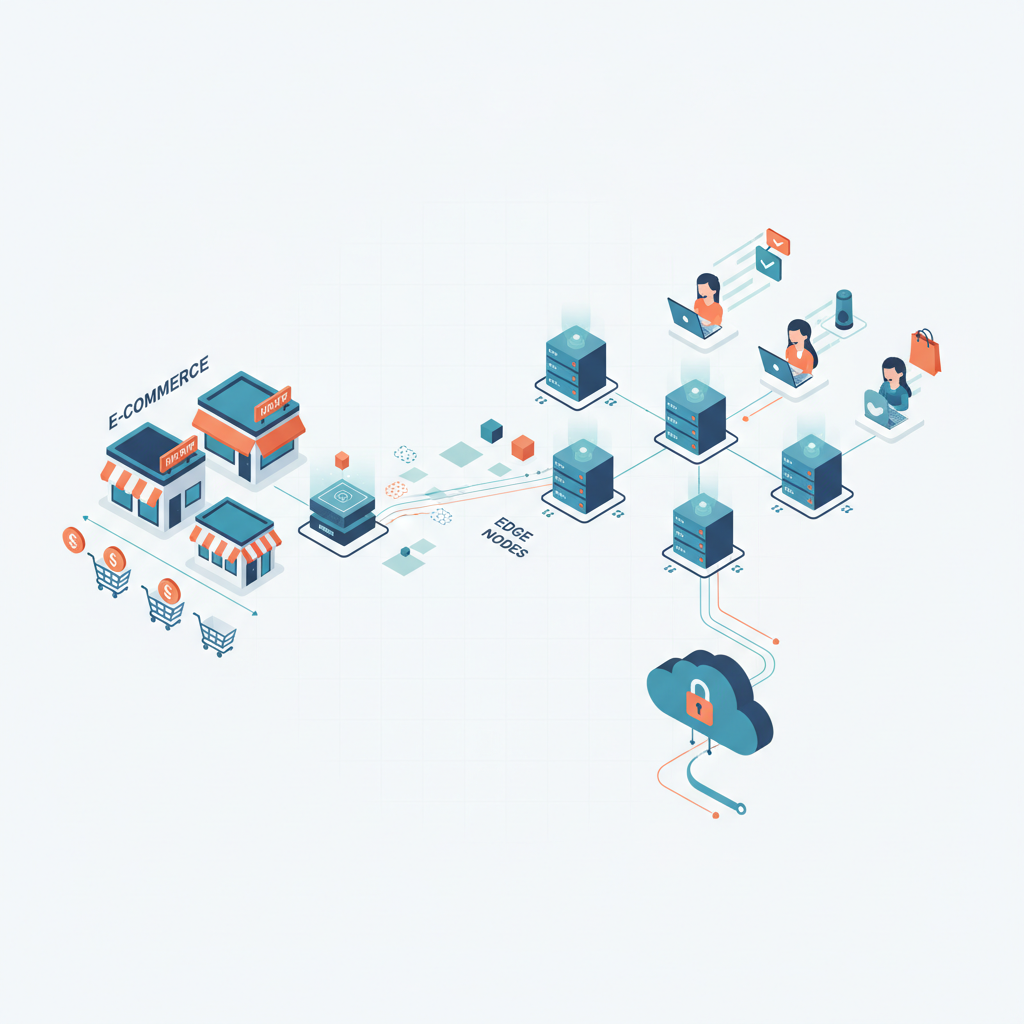
**Edge computing** is a distributed computing paradigm that brings computation and data storage closer to the sources of data, minimizing latency and bandwidth usage. This means processing information at or near the device or user, rather than sending it to a distant central data center. Edge computing differs from traditional cloud computing by processing data at or near the source of the data, such as a user’s device or a local server, rather than transmitting it to a distant central data center. This proximity drastically reduces latency and bandwidth usage, making it ideal for real-time e-commerce applications and enhancing local data privacy.
Compared to traditional cloud computing, which relies on centralized data centers, edge computing employs a distributed model. Data is processed locally, reducing the distance data travels. This approach directly addresses key e-commerce problems:
* **Latency reduction:** By processing data closer to the user, edge computing drastically cuts down the time it takes for data to travel and be processed. **Latency** is the delay before a transfer of data begins following an instruction for its transfer, directly impacting website load times and real-time interactions.
* **Bandwidth optimization:** Less data needs to be sent to and from a central cloud, saving bandwidth and reducing costs.
* **Enhanced data privacy:** Sensitive customer data can be processed and stored locally, aligning with stringent data privacy regulations like GDPR and CCPA.
Edge Computing for E-commerce 2026: Key Benefits for Speed
By 2026, edge computing will deliver significant performance benefits to e-commerce including dramatically reduced latency for faster website loading and transaction processing, improved real-time personalization and dynamic content delivery, and enhanced immersive experiences like AR/VR shopping. It will also optimize inventory management and logistics through real-time data processing at the edge. This shift means a more responsive and fluid online shopping journey for customers.
The speed advantages of **edge computing e-commerce** are transformative:
* **Reduced Latency:** Edge processing minimizes the physical distance data travels, leading to sub-millisecond response times. This is crucial for fast website loading, instant product recommendations, and seamless checkout processes, directly impacting conversion rates. A 2023 study by Portent indicated that a 1-second delay in page response can result in a 7% reduction in conversions.
* **Real-time Personalization:** Edge computing enables immediate analysis of user behavior data, allowing for dynamic content delivery and personalized product recommendations in real-time. This level of responsiveness is vital for engaging customers and driving sales.
* **Enhanced AR/VR Shopping:** **AR/VR Shopping** refers to Augmented Reality (AR) and Virtual Reality (VR) technologies applied to e-commerce, offering immersive and interactive shopping experiences for customers. These technologies demand ultra-low latency to provide a smooth, realistic experience. Edge computing makes AR/VR product try-ons and virtual showrooms viable, creating more engaging customer interactions.
* **Optimized Inventory and Logistics:** Real-time data from IoT (Internet of Things) devices at the edge (e.g., in warehouses or delivery vehicles) allows for instant inventory updates, predictive stock management, and optimized delivery routes. This efficiency reduces operational costs and improves customer satisfaction.
Edge Computing for E-commerce 2026: Bolstering Security
Edge computing enhances cybersecurity for online stores by creating a more distributed security model, which means fewer centralized points of failure that hackers can target. It also allows for sensitive data to be processed locally, improving data privacy and compliance, and enables faster detection and mitigation of cyber threats, including DDoS attacks, closer to the source of the attack. This approach significantly strengthens an e-commerce platform’s defense mechanisms.
The security benefits of edge computing are multifaceted and critical for safeguarding online businesses:
* **Distributed Security Model:** By decentralizing data processing, edge computing eliminates single points of failure that are common targets for cyber attackers in traditional cloud setups. This makes the entire system more resilient.
* **Enhanced Data Privacy and Compliance:** Processing sensitive customer data locally, rather than sending it to distant cloud servers, naturally improves data privacy. It also helps businesses comply with evolving data protection regulations, minimizing legal and reputational risks. According to a 2024 report by IBM, the average cost of a data breach globally reached $4.45 million, highlighting the importance of robust security measures.
* **Faster Threat Detection and Mitigation:** Security analytics can run directly at the edge, allowing for real-time monitoring and immediate response to suspicious activities. This proactive approach can detect and neutralize threats before they propagate across the network.
* **Protection Against DDoS Attacks:** Edge computing can filter malicious traffic closer to the source, making it more challenging for **DDoS Attacks** (a malicious attempt to disrupt the normal traffic of a targeted server, service, or network by overwhelming the target or its surrounding infrastructure with a flood of Internet traffic) to overwhelm central servers. This provides a robust first line of defense against volumetric attacks.
Implementing Edge Computing: A ‘Security-First Build’ Approach for E-commerce
A ‘security-first build’ approach for edge computing in e-commerce involves integrating security considerations at every stage, from initial concept and design to deployment and ongoing maintenance. This means prioritizing secure infrastructure, robust data governance policies, careful vendor selection, and implementing security measures like encryption and access controls throughout the distributed edge network from day one, rather than adding them as an afterthought. This proactive strategy is essential for protecting sensitive e-commerce data.
For businesses looking to adopt **edge computing e-commerce**, a “security-first build” approach is paramount. This philosophy, central to 360Locker’s operations, ensures cybersecurity is woven into the very fabric of the system, not bolted on later. Key considerations for businesses include:
* **Secure Infrastructure Design:** Establishing secure communication protocols, robust authentication mechanisms, and proper access controls across the distributed edge network from the outset.
* **Data Governance Policies:** Defining clear policies for data storage, processing, and retention at each edge node, ensuring compliance and privacy.
* **Careful Vendor Selection:** Partnering with providers who prioritize security and have a proven track record in developing secure, scalable solutions.
* **Continuous Monitoring:** Implementing real-time threat detection and vulnerability management across all edge devices and applications.
360Locker, founded on January 1, 2020, emphasizes a “security-first build” approach for all its website development, app development, and hosting services. Their expertise aligns perfectly with the secure implementation of edge computing. They provide 360-degree security, integrating cybersecurity from concept to deployment, offering a reliable pathway for businesses seeking secure, scalable digital solutions.
Real-World Applications & Future Trends for Edge E-commerce
By 2026, **edge computing e-commerce** will manifest in numerous real-world applications, profoundly impacting customer experience and operational efficiency. One prominent example is smart retail stores utilizing in-store analytics. Cameras and sensors at the edge can analyze customer foot traffic and behavior patterns in real-time, allowing retailers to optimize store layouts, personalize digital signage, and send localized promotions directly to shoppers’ phones. This offers a highly tailored and engaging shopping experience.
Further real-world applications include:
* **Connected Supply Chains:** IoT devices on pallets, vehicles, and warehouses leverage edge computing to provide real-time tracking, environmental monitoring (e.g., temperature for perishables), and predictive maintenance. This ensures efficient logistics and reduces waste.
* **Localized Promotions:** Edge computing can deliver highly relevant, location-based offers to customers as they browse a physical store or approach a specific point of interest, mirroring online personalization in the physical world.
* **Interactive Kiosks:** In-store kiosks powered by edge computing can offer instant product information, virtual try-ons, and seamless checkout experiences without relying on a constant cloud connection.
The synergy between edge computing, AI (Artificial Intelligence), and IoT will define future trends. Edge devices will collect vast amounts of data, which AI models processed at the edge can analyze instantaneously for predictive analytics and automation. This enables hyper-personalized customer journeys, proactive inventory management, and intelligent automation of various e-commerce processes, creating new business models focused on instant delivery and highly tailored experiences.
Partnering for Success: Secure & Scalable E-commerce Solutions
360Locker supports businesses in leveraging advanced technologies like edge computing by providing secure web development and hosting expertise, aligning with a ‘security-first build’ approach. They offer 360-degree security, creative engineering, 24/7 support, and affordable pricing for building scalable and future-ready e-commerce platforms, including secure application development and infrastructure that can facilitate edge computing implementations. Since its founding in 2020, 360Locker has served over 500 clients, delivering more than 120 projects.
Businesses aiming for secure and scalable **edge computing e-commerce** platforms can significantly benefit from 360Locker’s expertise. Their core value propositions directly address the needs of modern e-commerce:
* **360-Degree Security:** Integrating cybersecurity from concept to deployment ensures that edge computing implementations are secure from day one. This aligns with the necessity for robust data protection in a distributed environment.
* **Creative Engineering:** Delivering innovative solutions tailored to specific business needs, crucial for complex edge computing architectures.
* **24/7 Support:** Providing continuous assistance to manage the intricate nature of distributed systems and ensure uninterrupted service for e-commerce platforms.
* **Affordable Pricing:** Making advanced technologies accessible to a wider range of businesses, including newcomers to the web world.
360Locker offers a comprehensive suite of services, including website development, Android and iOS app development, secure hosting with 99.95% uptime, and free website migration. These services are foundational for any business looking to implement edge computing securely and efficiently. With sister concern ITpreneurs.Tech, 360Locker offers a complete ecosystem for digital success. For businesses seeking to build future-ready, secure, and lightning-fast e-commerce platforms leveraging technologies like edge computing, partnering with 360Locker provides the expertise and support needed for seamless digital transformation.
Frequently Asked Questions
What are the main challenges faced by e-commerce businesses regarding speed and security?
E-commerce businesses grapple with slow load times, frequent data breaches, the high user expectations for instant gratification, and the growing demand for robust data security and privacy in online shopping.
How does edge computing fundamentally differ from traditional cloud computing for e-commerce?
Edge computing fundamentally differs by processing data closer to the data source and user, rather than sending it to a distant centralized cloud. This distributed approach minimizes latency and bandwidth strain, which is crucial for real-time e-commerce interactions.
What specific performance benefits will edge computing bring to e-commerce by 2026?
By 2026, edge computing will bring benefits like reduced latency for faster website and transaction processing, improved real-time personalization and dynamic content delivery, and enhanced AR/VR shopping experiences for immersive retail applications.
How does edge computing enhance cybersecurity for online stores and customer data?
Edge computing enhances cybersecurity by creating a distributed security model with fewer centralized points of failure, enabling faster threat detection and mitigation closer to the source, and improving data privacy by processing sensitive data locally.
What considerations should e-commerce businesses have when planning to adopt edge computing solutions?
E-commerce businesses adopting edge computing should consider their infrastructure needs, data governance strategies, the importance of vendor selection, and how to integrate security from the outset of the project.
What real-world examples exist of edge computing improving e-commerce operations or customer experience?
Real-world examples include smart retail stores using in-store analytics for personalized offers, connected supply chains optimizing logistics, and localized promotions delivered based on real-time customer presence and preferences.