
Quick answer: Serverless security addresses the unique challenges of protecting ephemeral functions, APIs, and data interactions within cloud-native, event-driven architectures by implementing secure design principles, automated tools, robust IAM, and continuous monitoring.
Key takeaways
- Serverless computing introduces unique security challenges due to its distributed nature, shared responsibility model, and function-level vulnerabilities.
- Cost-effective serverless security relies on a ‘shift-left’ approach, automated tools, granular IAM, and comprehensive monitoring.
- Proactive measures, including secure coding and robust API gateways, are critical for mitigating evolving serverless attack vectors.
- A ‘security-first build’ approach integrates cybersecurity from the initial design phase through deployment and continuous operation.
- The future of serverless security will leverage AI/ML for automated threat response and continuous innovation to secure cutting-edge digital solutions.
Serverless security in 2026 is critical for protecting the ephemeral and distributed nature of cloud functions, ensuring applications remain resilient against evolving cyber threats while optimizing operational costs. The primary security challenges unique to serverless architectures include the intricate shared responsibility model, function-level vulnerabilities such as insecure code and excessive permissions, supply chain risks stemming from third-party dependencies, and the inherent difficulty in establishing traditional perimeter defenses due to their ephemeral and distributed nature. Businesses can achieve cost-effective serverless security by adopting a “shift-left” security approach, leveraging automated tools, implementing granular Identity and Access Management (IAM), and centralizing monitoring and logging.
Introduction to Serverless Computing and Its Security Implications
Serverless computing is a cloud execution model where the cloud provider dynamically manages the allocation and provisioning of servers, allowing developers to run code without provisioning or managing underlying infrastructure. This paradigm has seen rapid adoption, with major platforms like AWS Lambda, Azure Functions, and Google Cloud Functions leading the charge. Its benefits are substantial, including automatic scalability, reduced operational overhead, and significant cost efficiencies, as users only pay for the compute resources consumed.
However, the shift to serverless introduces unique security challenges. These include the intricate shared responsibility model, where the cloud provider secures the infrastructure, but the customer is responsible for security *in* the cloud, meaning their code, configurations, and data. Function-level vulnerabilities, supply chain risks from third-party dependencies, and the difficulty in establishing traditional perimeter defenses due to the ephemeral and distributed nature of functions further complicate security.
The Evolving Threat Landscape for Serverless Architectures
The threat landscape for serverless architectures is constantly evolving, demanding proactive security measures. Current and projected serverless attack vectors include the OWASP Serverless Top 10 risks, which highlight concerns like injection flaws, broken authentication, and insecure configurations. These vulnerabilities can lead to unauthorized access or data breaches. For example, a recent report indicated that misconfigurations account for over 80% of cloud security incidents.
Advanced threats in 2026 also encompass side-channel attacks, denial-of-service (DoS) attacks specifically targeting individual functions, and sophisticated data exfiltration techniques. Given the ephemeral and distributed nature of serverless functions, traditional security tools often struggle to provide comprehensive protection. This underscores the need for specialized serverless security solutions that can adapt to rapid changes and dynamic environments.
Key Pillars of Cost-Effective Serverless Security in 2026
Achieving robust serverless security does not have to be prohibitively expensive. Businesses can achieve cost-effective serverless security by adopting a “shift-left” security approach with secure design principles, leveraging automated security tools for continuous protection, implementing granular Identity and Access Management (IAM) policies, and centralizing monitoring and logging for real-time threat detection and anomaly identification.
How do secure design principles contribute to cost-effective serverless security?
Secure design principles are foundational for cost-effective serverless security. Shift-left security, the practice of integrating security considerations and practices earlier into the software development lifecycle, helps identify and mitigate vulnerabilities at the design and coding stages. This proactive approach significantly reduces the cost of remediation compared to fixing issues later. Key practices include secure coding, input validation, and implementing the principle of least privilege. Least privilege is a security principle where users, programs, or processes are granted only the minimum necessary permissions or access rights required to perform their specific tasks. This minimizes the potential blast radius of a compromised function.
What role do automated security tools play in securing serverless functions?
Automated tools are vital for securing serverless functions by providing essential capabilities such as runtime protection, serving as API security gateways, facilitating configuration management, and conducting automated vulnerability scanning for serverless functions. These tools enable continuous security integration within CI/CD pipelines, automating threat detection and response in the dynamic and ephemeral serverless environment. This automation reduces manual effort, improves consistency, and ensures faster detection of threats. According to Gartner, by 2025, 75% of security failures will result from inadequate management of identities, access, and privileges, highlighting the importance of automated IAM.
Why is Identity and Access Management (IAM) crucial for serverless?
Identity and Access Management (IAM) is crucial for serverless architectures because it provides granular control over function execution and resource access. With numerous functions potentially interacting with various cloud services, precisely defining what each function can do and access is paramount. Strong IAM policies enforce the principle of least privilege, preventing functions from accessing resources they don’t need. This minimizes the impact of a potential breach, even if a function is compromised.
How do monitoring and logging enhance serverless security?
Monitoring and logging enhance serverless security by providing visibility into function activity and potential threats. Centralized logging aggregates logs from all serverless functions and related services. Real-time threat detection leverages these logs to identify suspicious patterns or anomalies, such as unusual invocation patterns or unauthorized API calls. This allows for rapid response to incidents. Specialized serverless monitoring tools can track function performance, errors, and security events, offering a comprehensive view of the security posture.
Building Scalable Serverless Defenses with 360Locker’s Expertise
360Locker, founded on January 1, 2020, brings a “security-first build” approach to serverless development, integrating cybersecurity from concept to deployment. This commitment ensures that security is not an afterthought but an intrinsic part of every serverless project. We’ve served over 500 clients and delivered 120+ projects, with an average delivery time of 30-60 days. Our expertise extends to secure, scalable digital solutions for various businesses, including e-commerce platforms, leveraging serverless technologies.
How does a ‘security-first build’ apply specifically to serverless development?
In serverless development, a “security-first build” means integrating cybersecurity considerations from the initial conceptualization phase through design, coding, testing, and deployment. This includes implementing secure coding practices, configuring minimal permissions for functions, securing API gateways, and ensuring continuous security validation throughout the entire CI/CD pipeline for every serverless function and interaction. 360Locker ensures that every function, from an AWS Lambda endpoint to an Azure Function, is developed with security as its primary directive. This proactive stance, aligned with our sister concern ITpreneurs.Tech, significantly reduces vulnerabilities.
360Locker’s 360-degree security strategy is applied comprehensively to serverless. This involves securing function code itself against common vulnerabilities, meticulously configuring function environments and permissions, protecting API gateways that serve as entry points to functions, and ensuring secure data interactions throughout the serverless ecosystem. Our 24/7 support and affordable pricing further ensure that businesses, including newcomers to the web world, can access robust serverless security solutions without compromising their budget or peace of mind.
Best Practices for Implementing Serverless Security: A Practical Guide
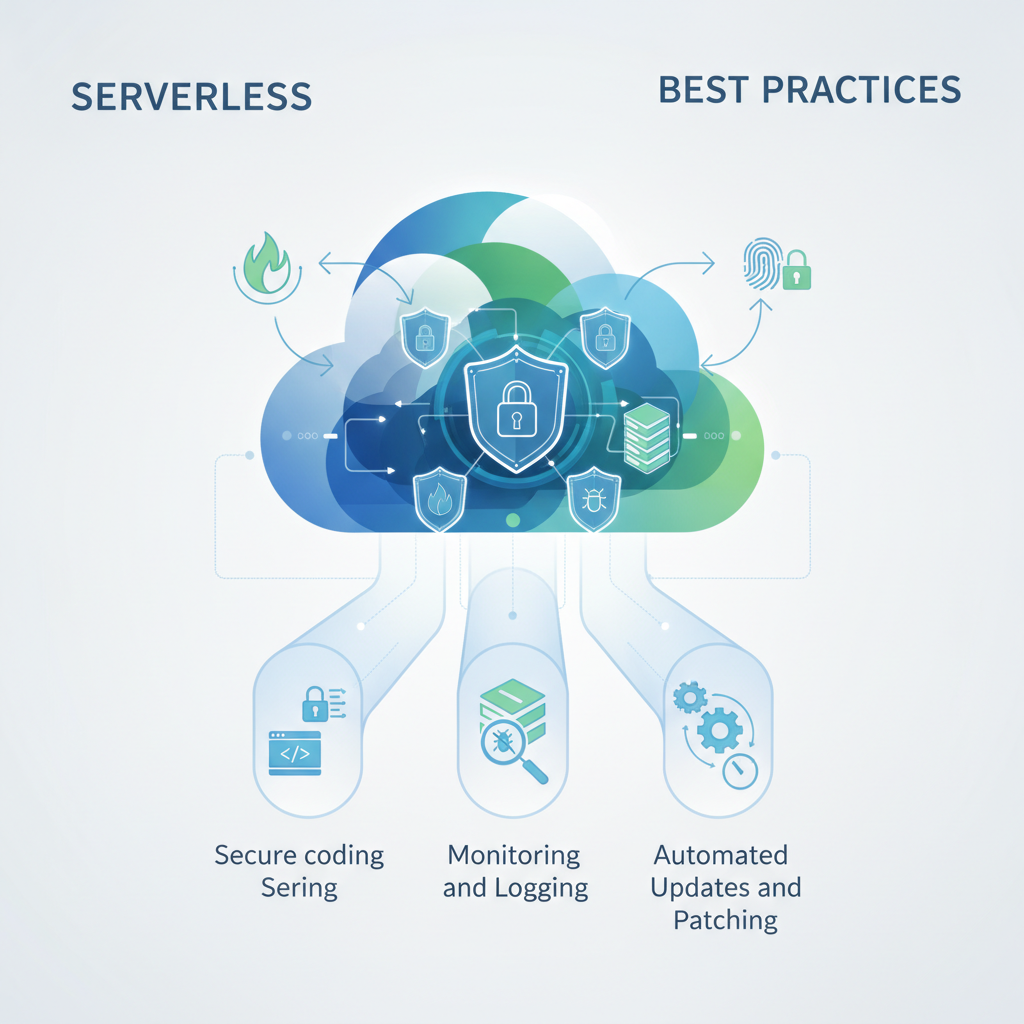
Implementing robust serverless security requires a combination of strategic planning and tactical execution. These best practices are essential for safeguarding your serverless applications in 2026.
- Implement a Robust API Gateway for Ingress/Egress Control: An API Gateway acts as the front door for your serverless functions, providing essential controls for authentication, authorization, rate limiting, and traffic management. This centralizes access control and protects functions from direct exposure.
- Encrypt Data at Rest and in Transit: Always encrypt sensitive data, whether it’s stored in a database (at rest) or moving between services (in transit). Utilize services like AWS Key Management Service (KMS) for managing encryption keys and protecting secrets, minimizing the risk of data exfiltration.
- Regularly Audit and Update Function Dependencies and Runtimes: Serverless functions often rely on numerous third-party libraries and specific runtime environments. Regularly scanning for vulnerabilities in these dependencies and keeping runtimes updated is crucial to prevent supply chain attacks and exploitation of known weaknesses.
- Utilize Serverless-Specific Security Tools and Frameworks: Generic security tools may not be sufficient for the unique challenges of serverless. Invest in specialized tools for runtime protection, configuration auditing, and vulnerability scanning tailored for serverless functions.
- Embrace DevSecOps Practices for Continuous Security Integration: Integrate security into every stage of your CI/CD pipeline. This means automating security checks, performing static and dynamic application security testing (SAST/DAST), and ensuring that security is a shared responsibility across development and operations teams.
The Future of Serverless Security and 360Locker’s Vision
The future of serverless security in 2026 will be largely driven by advancements in artificial intelligence and machine learning. These technologies will enable more sophisticated anomaly detection, predictive threat intelligence, and automated threat response, reducing the need for manual intervention. As serverless becomes integral to edge computing, IoT, and microservices, its security landscape will continue to evolve, demanding adaptive and intelligent defense mechanisms.
360Locker is committed to continuous innovation in securing cutting-edge digital solutions. Our experience, drawn from helping 500+ clients and delivering 120+ projects, informs our approach to future-proofing serverless applications. We understand the challenges faced by newcomers in the web world and provide tailored guidance and solutions. As a leader in secure, scalable web and app development, 360Locker actively embraces these emerging security trends, ensuring our clients receive the most advanced protection for their serverless deployments and digital transformations.
Conclusion: Securing Your Serverless Future
Proactive, cost-effective, and scalable serverless security is not just a best practice; it is an imperative for businesses embracing cloud-native architectures in 2026. The unique challenges of serverless demand a specialized approach that goes beyond traditional security models. The essential components of a scalable serverless security strategy encompass secure design principles like shift-left security and least privilege, the deployment of automated security tools for runtime protection and API security, robust Identity and Access Management (IAM), and comprehensive, serverless-specific monitoring and logging solutions for continuous threat detection.
360Locker’s unique value proposition, with its “security-first build” philosophy and 360-degree security strategy, provides a reliable pathway to secure and scalable serverless solutions. By leveraging expert knowledge, 24/7 support, and affordable pricing, 360Locker helps businesses confidently navigate the complexities of serverless computing. For businesses seeking secure serverless deployments and robust digital transformation, partnering with an expert like 360Locker is crucial for building a resilient and protected future.
Frequently Asked Questions
What are the primary security challenges unique to serverless architectures?
Serverless architectures face unique security challenges including a complex shared responsibility model, function-level vulnerabilities (e.g., insecure code, excessive permissions), supply chain risks from third-party dependencies, and difficulties in traditional perimeter defense due to their ephemeral and distributed nature.
How can businesses achieve cost-effective serverless security without compromising protection?
Businesses can achieve cost-effective serverless security by embracing a ‘shift-left’ security approach with secure design principles, implementing automated security tools for continuous protection, utilizing granular Identity and Access Management (IAM), and centralizing monitoring and logging for real-time threat detection.
What are the essential components of a scalable serverless security strategy?
Essential components of a scalable serverless security strategy include secure design principles (e.g., least privilege, secure coding), automated security tools (runtime protection, API gateways), robust Identity and Access Management (IAM), and comprehensive monitoring and logging solutions tailored for serverless environments.
What role do automated tools play in securing serverless functions?
Automated tools are crucial in securing serverless functions by providing runtime protection, acting as API security gateways, managing configurations, and performing vulnerability scanning. They enable continuous security integration in CI/CD pipelines, automating detection and response to evolving threats in dynamic serverless environments.
How can 360Locker help businesses implement robust serverless security measures for their digital solutions?
360Locker helps businesses implement robust serverless security by integrating a ‘security-first build’ approach from concept to deployment, applying a 360-degree security strategy to protect function code, configurations, APIs, and data, and offering 24/7 support with affordable pricing for comprehensive secure, scalable digital solutions.
What will be the future trends in serverless security by 2026?
By 2026, future trends in serverless security will likely include significant advancements in AI/ML-driven security for automated threat response, increased focus on securing serverless components in emerging technologies, and continuous innovation in tools and frameworks to handle the evolving, dynamic nature of serverless architectures.