
Quick answer: API security for e-commerce in 2026 focuses on protecting sensitive data and maintaining user trust against an evolving landscape of threats, requiring a multi-layered approach from foundational measures to advanced AI-powered defenses.
Key takeaways
- E-commerce APIs face increasing threats from sophisticated attacks like bots and credential stuffing, demanding robust security.
- Key challenges include managing access control in distributed architectures and ensuring compliance with data privacy regulations.
- Foundational security pillars like strong authentication, data encryption, and input validation are critical for API protection.
- Advanced strategies, including AI/ML threat detection and a 'security-first' development lifecycle, enhance defense.
- Future API security will likely involve zero-trust architectures and quantum-resistant cryptography to combat emerging threats.
**API security** is paramount for e-commerce platforms in 2026, protecting sensitive customer data and ensuring transactional integrity. The most significant threats include sophisticated bots, credential stuffing, distributed denial-of-service (DDoS) attacks, and data breaches targeting API vulnerabilities, often amplified by new attack vectors and the OWASP API Security Top 10 risks. Effective API security balances robust protection with high performance and a seamless user experience through measures like strong authentication, data encryption, API gateways, and a “security-first build” approach.
The Evolving Threat Landscape for E-commerce APIs
The e-commerce landscape relies heavily on APIs for critical functions like payment processing, inventory management, and customer data synchronization. The growth of these platforms has unfortunately led to a corresponding increase in sophisticated threats, making API security a top concern for businesses as of 2026. This reliance makes APIs a primary target for cybercriminals.
New vulnerabilities are constantly emerging, highlighted by updates to the OWASP API Security Top 10. The OWASP API Security Top 10 is a standard awareness document for developers and security professionals outlining the most critical web application security risks, specifically tailored for APIs. Attackers employ sophisticated attack vectors, including automated bot attacks, credential stuffing, and DDoS campaigns, to disrupt services or steal valuable data. Credential stuffing is a cyberattack where stolen account credentials, typically consisting of lists of usernames and passwords, are used to gain unauthorized access to user accounts on other services. The impact of such breaches on businesses can be severe, encompassing significant financial losses, irreparable reputational damage, and a crucial erosion of customer trust. According to a 2024 report by IBM, the average cost of a data breach reached an all-time high of $4.35 million.
Key API Security Challenges for E-commerce in 2026
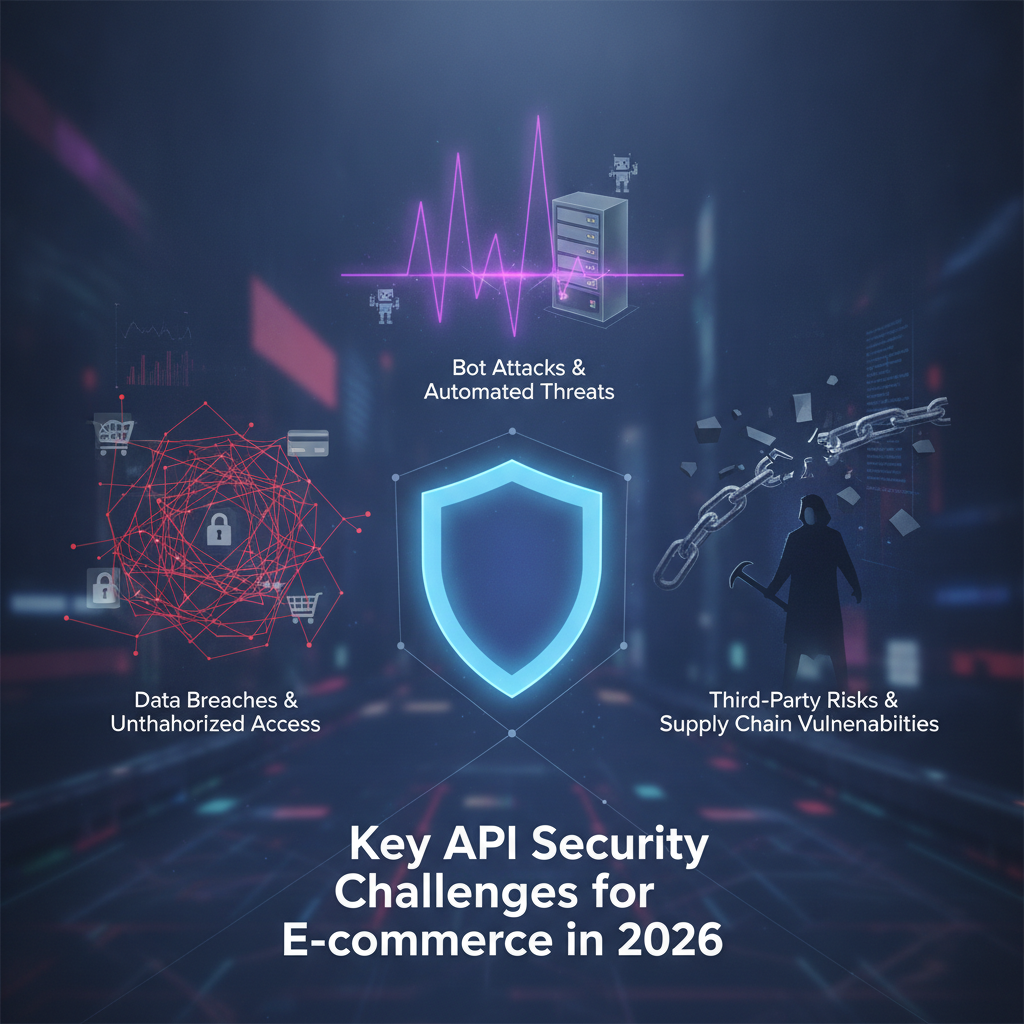
E-commerce businesses in 2026 face several distinct API security challenges due to the complex nature of modern digital platforms. Modern e-commerce architectures often use microservices, distributing functionalities across many smaller, independent services that communicate via APIs. This distributed nature, coupled with numerous third-party integrations for services like shipping or marketing, creates a broader attack surface.
Managing access control and authorization at scale becomes a significant hurdle. Ensuring only authorized users and applications can access specific API endpoints requires fine-grained controls across potentially thousands of distinct API calls. Data privacy regulations, such as GDPR in Europe and CCPA in California, impose strict requirements on how customer data is handled through APIs, demanding meticulous compliance efforts. Businesses must also strike a delicate balance between implementing robust security measures and maintaining a seamless user experience, as overly complex security steps can deter customers. Finally, achieving adequate visibility and continuous monitoring of API traffic for anomalies is critical for early threat detection, but often challenging to implement comprehensively.
What are the most significant API security threats facing e-commerce platforms in 2026?
The most significant API security threats facing e-commerce platforms in 2026 include sophisticated bots, credential stuffing, distributed denial-of-service (DDoS) attacks, and data breaches targeting API vulnerabilities, often amplified by new attack vectors and the OWASP API Security Top 10 risks. These threats aim to exploit weaknesses in authentication, authorization, or data handling within the API layer. Such attacks can lead to unauthorized access, data theft, and service disruptions, severely impacting business operations and customer confidence.
Foundational Pillars of E-commerce API Protection
Protecting sensitive e-commerce data requires a multi-layered approach grounded in several essential API security measures. These foundational pillars ensure the integrity, confidentiality, and availability of API-driven services. Implementing these measures from the outset significantly strengthens an e-commerce platform’s defense against common and advanced threats.
These foundational measures include:
* **Authentication & Authorization:** Strong mechanisms like OAuth 2.0, JSON Web Tokens (JWT), and API keys are crucial. They verify the identity of users and applications (authentication) and determine what specific resources they are allowed to access (authorization). Fine-grained access controls prevent unauthorized actions.
* **Data Encryption:** All data transmitted through APIs must be encrypted in transit using Transport Layer Security (TLS/SSL). Sensitive data at rest, such as customer payment information in databases, also requires robust encryption to protect against breaches.
* **Input Validation & Output Encoding:** These practices are vital for preventing injection attacks, such as SQL injection or cross-site scripting (XSS). Input validation ensures that API inputs conform to expected formats and types, while output encoding sanitizes data before it is displayed to users.
* **Rate Limiting & Throttling:** These controls mitigate the impact of DDoS and brute-force attacks by restricting the number of API requests a user or client can make within a specified timeframe. This prevents resource exhaustion and credential stuffing.
* **API Gateway:** An API Gateway acts as a single entry point for all API calls, enforcing security policies, managing traffic, and routing requests to the appropriate backend services. This centralized control point is essential for consistent security enforcement.
What foundational API security measures are essential for protecting sensitive e-commerce data?
Essential foundational API security measures for protecting sensitive e-commerce data include strong authentication and authorization (e.g., OAuth, JWT, API keys), comprehensive data encryption (in transit and at rest), rigorous input validation and output encoding to prevent injection attacks, and effective rate limiting and throttling to mitigate brute-force and DDoS attacks. These measures form the core defense against most common API exploits, safeguarding both customer information and system integrity.
Advanced Strategies for API Performance and Security Integration

Beyond foundational measures, e-commerce platforms need advanced strategies to integrate API security seamlessly with performance, especially as threats evolve. These strategies focus on proactive defense, real-time threat intelligence, and continuous improvement. Adopting these advanced techniques helps maintain a competitive edge while safeguarding digital assets.
Key advanced strategies include:
* **AI/ML-powered threat detection and anomaly behavioral analysis:** These systems learn normal API traffic patterns and can identify deviations in real-time. They detect sophisticated attacks that bypass traditional signature-based defenses. For example, machine learning can spot a credential stuffing attempt by recognizing an unusual volume of failed login attempts from a specific IP range.
* **API Firewalls (WAF) and bot management solutions:** A Web Application Firewall (WAF) filters and monitors HTTP traffic between a web application and the internet. It protects web applications from various attacks, including those targeting APIs. Specialized bot management solutions differentiate legitimate user traffic from malicious automated bots, preventing fraud and resource abuse.
* **Runtime API self-protection (RASP):** RASP technology integrates security into the application runtime environment. It actively monitors API calls and application behavior from within, blocking attacks in real-time without requiring human intervention. This provides a deeper layer of defense than perimeter solutions alone.
* **Implementing a ‘security-first’ development lifecycle (Shift-Left security):** This approach integrates security considerations from the very first stages of API design and development, rather than as an afterthought. Identifying and fixing vulnerabilities early saves significant time and cost down the line.
* **Continuous API testing and vulnerability assessments:** Regular penetration testing, security audits, and automated vulnerability scanning are crucial. These practices identify new weaknesses and ensure that security controls remain effective against the latest threats.
How can e-commerce businesses balance robust API security with high performance and a seamless user experience?
E-commerce businesses can balance robust API security with high performance and a seamless user experience by employing API gateways for centralized enforcement, implementing efficient rate limiting and throttling, and integrating security measures early in the ‘shift-left’ development lifecycle to optimize without compromising user flow. This approach ensures that security is baked in, rather than bolted on, minimizing performance overhead while maximizing protection. Solutions like advanced bot management also help filter malicious traffic without inconveniencing legitimate users.
360Locker’s Approach to Secure & Performant E-commerce APIs
360Locker, founded on January 1, 2020, prioritizes a “security-first build” for all its digital solutions, including those for e-commerce APIs. This philosophy means integrating cybersecurity from the initial concept phase right through to deployment, ensuring that APIs are inherently secure and resilient. With over 500 clients served and 120+ projects delivered, 360Locker understands the unique security needs of businesses.
The company’s expertise extends to integrating robust cybersecurity into all aspects of website and app development for both Android and iOS platforms. This holistic approach ensures that every touchpoint, including critical APIs, is protected. 360Locker leverages 360-degree security, a comprehensive framework that covers all potential attack vectors and vulnerabilities within an e-commerce ecosystem. This includes proactive threat detection, secure coding practices, and continuous monitoring.
Crucially, 360Locker ensures that scalability and performance are never compromised by robust security measures. Their solutions are engineered to handle high traffic volumes common in e-commerce, offering a 99.95% uptime hosting guarantee. This provides a secure infrastructure where APIs can operate efficiently without performance bottlenecks. Clients also benefit from 24/7 support for ongoing API security management, ensuring any issues are addressed promptly. As a sister concern of ITpreneurs.Tech, 360Locker combines specialized security knowledge with broad IT expertise. They also offer free website migration, making it easier for businesses to transition to a more secure and performant platform.
How does a ‘security-first’ development approach impact API protection for online stores?
A ‘security-first’ development approach integrates security considerations from the initial design phase through deployment, proactively identifying and mitigating vulnerabilities, leading to more resilient and inherently secure APIs for online stores. This method, championed by 360Locker, reduces the cost and complexity of fixing security flaws later in the development cycle. It ensures that protection is built into the core architecture, rather than being an afterthought, creating a stronger defense against cyber threats.
The Future of E-commerce API Security: Beyond 2026
Looking beyond 2026, the future of e-commerce API security will be defined by an increasing shift towards more adaptive, granular, and resilient defense mechanisms. Traditional perimeter-based security is becoming less effective against modern threats. Therefore, innovative architectures and technologies will take center stage.
One major trend is the widespread adoption of zero-trust architecture for APIs. Zero-trust architecture is a security model that requires strict identity verification for every person and device trying to access resources on a private network, regardless of whether they are inside or outside the network perimeter. This “never trust, always verify” principle minimizes the risk of internal breaches. Another emerging concept is the API security mesh, which decentralizes security controls and distributes them closer to the APIs themselves, offering more granular and context-aware protection. The development of quantum-resistant cryptography will also become vital, safeguarding sensitive e-commerce data against potential threats from quantum computing. Ultimately, continuous adaptation to emerging threats and technologies will be paramount, requiring e-commerce platforms to remain agile and proactive in their security posture.
What role do AI and machine learning play in future API security strategies for e-commerce?
AI and machine learning play a pivotal role in future API security strategies for e-commerce by enabling advanced threat detection, real-time anomaly behavioral analysis, and automated response capabilities, allowing systems to adapt continuously to emerging and sophisticated attack vectors more effectively than traditional methods. These technologies can identify subtle patterns indicative of a breach or attack, even when human analysts might miss them, enhancing proactive defense.
Frequently Asked Questions
What are the most significant API security threats facing e-commerce platforms in 2026?
In 2026, e-commerce platforms face significant API security threats including sophisticated bots, credential stuffing, DDoS attacks, and data breaches, often exploiting vulnerabilities outlined in the OWASP API Security Top 10.
How can e-commerce businesses balance robust API security with high performance and a seamless user experience?
E-commerce businesses can balance security and performance by implementing efficient security measures like API gateways for centralized enforcement, rate limiting, and integrating security early in the development lifecycle to optimize both aspects without compromising user experience.
What foundational API security measures are essential for protecting sensitive e-commerce data?
Essential foundational API security measures for protecting sensitive e-commerce data include strong authentication and authorization (e.g., OAuth, JWT), data encryption in transit and at rest, rigorous input validation, output encoding, and rate limiting to prevent common attack vectors.
How does a 'security-first' development approach impact API protection for online stores?
A 'security-first' development approach integrates security considerations from the initial design phase through deployment, proactively identifying and mitigating vulnerabilities, leading to more resilient and inherently secure APIs for online stores.
What role do AI and machine learning play in future API security strategies for e-commerce?
AI and machine learning play a crucial role in future API security by enabling real-time threat detection, anomaly behavioral analysis, and automated responses to sophisticated attacks, significantly enhancing the adaptive capabilities of e-commerce security systems.
How can 360Locker help e-commerce businesses build secure, scalable, and high-performing API-driven platforms?
360Locker helps by emphasizing a 'security-first build' integrated into website and app development, leveraging 360-degree security for comprehensive protection, ensuring scalability and performance, and providing 24/7 support with secure, high-uptime hosting.