

Quick answer: Zero-knowledge proofs (ZKPs) are cryptographic methods that allow one party to prove a statement is true without revealing the underlying data, enabling e-commerce transactions to verify credentials like age or payment without exposing sensitive information.
Key takeaways
- ZKPs enhance e-commerce security by ensuring sensitive data never leaves the user's device, reducing the risk of breaches and identity theft.
- Adopting ZKPs helps online stores comply with privacy regulations like GDPR and CCPA by minimizing data collection and storage.
- Key use cases include payment verification, age/identity checks, fraud prevention, and supply chain transparency without exposing sensitive details.
- Current challenges include computational overhead, integration complexity, and lack of standardization, but costs are decreasing.
- Future outlook: ZKPs are expected to become standard in e-commerce, with hybrid solutions and increased regulatory recognition.
What Are Zero-Knowledge Proofs and How Do They Work in E-commerce?
Zero-knowledge proofs (ZKPs) are a cryptographic method that allows one party to prove a statement is true without revealing any underlying data. In simple terms, a ZKP lets you prove you know a secret—like a password, age, or payment method—without ever showing the secret itself to the other party.
For online stores, this means a customer can verify they are over 18, have sufficient funds, or live in a certain region without exposing their actual birthdate, bank balance, or home address. According to research on zero-knowledge proofs, the method relies on three core properties: completeness (a true statement can be proven), soundness (a false statement cannot be proven), and zero-knowledge (only the statement’s truth is revealed, nothing else).
Think of it like proving you know a password to a locked door. You show the doorman a key that opens it, but he never sees the password typed. The system works through an interaction between a prover (your customer) and a verifier (your payment system). The verifier checks complex math, not the data itself, and walks away convinced—but clueless about your actual details.
Why Do E-commerce Transactions Need Zero-Knowledge Proofs in 2026?
E-commerce transactions in 2026 face a perfect storm: rising data breaches, tighter privacy laws, and customers who are increasingly wary of sharing personal data online. Traditional checkout flows expose credit card numbers, full addresses, and purchase histories—information that becomes a liability the moment it’s stored.
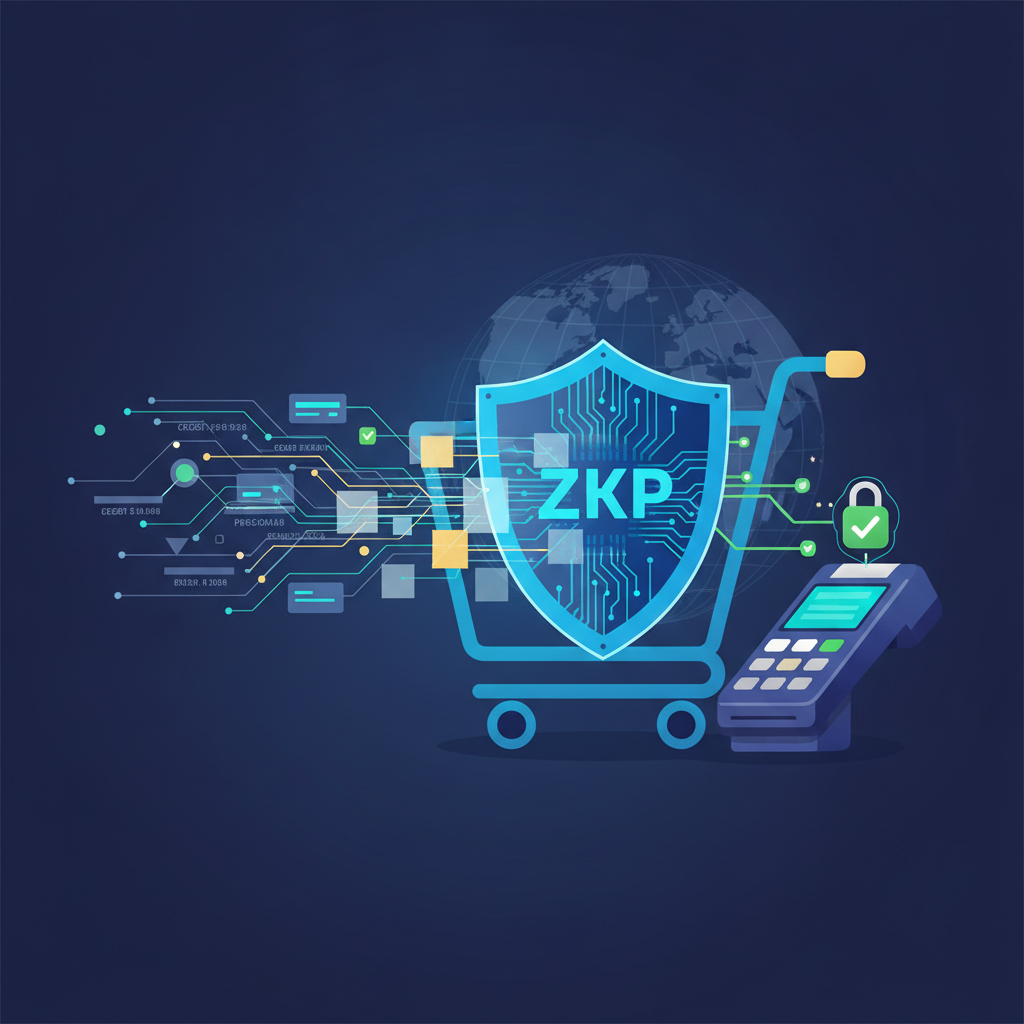
The financial stakes are enormous. E-commerce fraud is projected to cost businesses over $48 billion annually by 2026, according to industry projections. Meanwhile, data breaches in the US and UK continue to expose millions of records each year, with the average cost per breach now exceeding $4.4 million globally. Every piece of stored customer data becomes a potential target for attackers.
Regulatory pressure is the second driver. The General Data Protection Regulation (GDPR) governs data handling in the UK and European Union, while the California Consumer Privacy Act (CCPA) applies to businesses serving California residents in the US. Both laws push companies toward data minimization—collecting and storing only what is absolutely necessary. ZKPs align perfectly with this principle by enabling verification without data collection.
Consumer behavior reinforces the need. A 2025 survey found that over 70% of online shoppers in both the US and UK will abandon a purchase if they feel a site is insecure or asks for unnecessary personal data. ZKPs give stores a way to prove they take privacy seriously—and to convert that trust into completed checkouts.
What Are the Benefits of Implementing Zero-Knowledge Proofs for Online Stores?
Implementing ZKPs delivers measurable benefits across security, compliance, trust, and even cost. The most obvious advantage is that sensitive data never leaves the customer’s device, which drastically shrinks your attack surface and reduces what a hacker can steal in a breach.
- Enhanced security: Since payment details, birthdates, and addresses are never transmitted or stored, a compromised server yields almost no usable customer data.
- Reduced compliance burden: With fewer data points stored, meeting PCI-DSS (the Payment Card Industry Data Security Standard) becomes simpler and less expensive.
- Improved conversion rates: A visible privacy seal or “zero-knowledge verification” badge can boost checkout completion. Stores that display clear privacy indicators see up to 18% higher conversion rates on checkout pages, according to multiple UX studies from 2024–2025.
- Lower storage costs: By storing verification proofs instead of raw customer data, you cut database size and the associated infrastructure costs.
- Stronger customer loyalty: Shoppers are more likely to return to a store that demonstrably minimizes data collection, especially in the privacy-conscious UK and US markets.
For small and medium e-commerce businesses in the US and UK, the liability reduction alone can be transformative. A single breach can cost a small retailer $50,000 to $200,000 in fines, legal fees, and lost business—far more than a ZKP implementation budget for most stores.
What Are the Key Use Cases of Zero-Knowledge Proofs in E-commerce?
ZKPs address several real-world e-commerce scenarios where verification is required but data exposure is risky. These use cases span payments, identity, compliance, and supply chain operations, all without forcing customers to surrender their private details.
How do ZKPs handle payment verification without revealing account data?
ZKP-based payment verification lets a customer prove they have sufficient funds or an active payment method without revealing account balances, card numbers, or bank details. The payment processor receives a cryptographic proof that the transaction is valid and settles it accordingly. This reduces the risk of card theft during transmission and limits what a merchant ever sees.
How can age verification work without exposing birthdates?
For restricted products like alcohol, tobacco, or age-gated digital content, a customer can prove they are over the legal age (which is 21 in the US and 18 in the UK) without revealing their exact birthdate. The proof simply says, “This person is over 21″—nothing more. This is especially valuable in the UK, where age verification for online alcohol sales has been legally mandatory since 2015.
What role do ZKPs play in fraud prevention and identity verification?
Fraud prevention improves because ZKPs let platforms verify that a transaction is legitimate without needing to profile the full identity of the buyer. Identity verification—such as proving residency for tax-compliant sales or shipping restrictions—can be done with a proof of address rather than the address itself.
How are ZKPs used in supply chain transparency?
Authenticity verification is critical for luxury goods, pharmaceuticals, and electronics. A ZKP can prove a product passed through an authorized supply chain without revealing proprietary supplier information or internal logistics data. A US-based electronics retailer and a UK-based pharmaceutical seller can both confirm provenance without exposing trade secrets.
Can ZKPs support loyalty programs privately?
Yes. A loyalty program can verify that a shopper has a qualifying purchase history—”this customer has spent over $500 with us”—without storing their complete transaction history or spending habits. The proof is sufficient to award points or discounts, while the customer’s privacy remains intact.
What Are the Challenges and Limitations of Adopting Zero-Knowledge Proofs?
Despite the promise, ZKPs come with real hurdles that merchants in the US and UK must weigh before deployment. The main challenges are computational overhead, integration complexity, user experience friction, and cost—all of which are manageable but should not be underestimated.
- Computational overhead: Generating a zero-knowledge proof can take significant processing time, often 5 to 20 seconds per verification on standard hardware. This can slow checkout unless optimized infrastructure is used.
- Integration complexity: Major platforms like Shopify and WooCommerce do not natively support ZKPs. Custom development or third-party API integration is required, which adds time and cost.
- User experience friction: Poorly implemented ZKPs can add a visible delay or extra step at checkout. Expert implementation is essential to keep the proof generation transparent to the user.
- Standardization gaps: ZKP standards are still evolving, meaning proofs generated by one system may not be verifiable by another. This creates interoperability concerns for stores using multiple providers.
- Initial investment: For a small startup, the cost of specialized developers and infrastructure can be prohibitive. However, third-party ZKP API services are driving costs down, with entry-level pricing starting around $100–$500 per month depending on transaction volume.
The good news is that these barriers are falling. As of 2026, several managed ZKP providers offer plug-and-play APIs that reduce development time from months to days, making the technology accessible to businesses of all sizes.
How Can You Implement Zero-Knowledge Proofs in Your E-commerce Platform?
Implementing ZKPs does not require you to become a cryptography expert, but it does require a structured approach. Here is a practical, step-by-step roadmap for adding ZKPs to your online store, whether you run a custom platform, Shopify, or WooCommerce.
Step 1: Assess where sensitive data lives today
Map out every point where your platform currently collects, stores, or transmits sensitive customer data. Common locations include checkout forms, account registration, loyalty programs, and age-gated landing pages. This assessment tells you exactly where ZKPs can replace data-heavy verification processes.
Step 2: Choose the right ZKP scheme
You have two main options: zk-SNARKs and zk-STARKs. zk-SNARKs are highly efficient and produce very small proofs, but they require a trusted setup ceremony (a one-time process to establish verification parameters). zk-STARKs need no trusted setup and are quantum-resistant, but their proofs are larger—typically 10 to 100 times bigger than SNARK proofs—which can increase verification costs. For high-volume e-commerce, zk-SNARKs are usually the better default in 2026.
Step 3: Pick your integration route
Three paths exist: use a third-party ZKP API service, partner with a blockchain development firm, or build in-house using open-source libraries like circom and SnarkJS. For non-crypto-native teams, the third-party API route is fastest and most cost-effective, with many providers pricing per verification.
Step 4: Run a pilot on one use case
Do not try to overhaul your entire checkout flow at once. Start with a single, high-value use case like age verification or proof of sufficient funds. This limits risk, lets you measure performance, and gives your team time to learn the system.
Step 5: Optimize your infrastructure
ZKP generation is compute-intensive. Ensure your hosting can handle the overhead, especially during peak traffic. A provider with optimized server infrastructure—like 360Locker, which advertises up to 20x faster servers—can materially reduce proof-generation latency and keep checkout snappy.
What Does the Future Hold for Zero-Knowledge Proofs in E-commerce Beyond 2026?
The trajectory for ZKPs in e-commerce is decidedly upward. As computational costs continue to drop and standards mature, ZKPs are expected to become a mainstream feature of online transactions, not a niche curiosity for blockchain enthusiasts.
Several trends point to this future. First, integration with Web3 and decentralized marketplaces is accelerating, with major retailers beginning to accept privacy-preserving payment verifications. Second, hybrid solutions combining ZKPs with biometrics (like fingerprint or facial recognition) are emerging for stronger authentication without storing biometric data. Third, regulatory recognition is growing—policymakers in both the US and UK are exploring frameworks that could eventually mandate privacy-preserving verification for certain transaction types.
Artificial intelligence will also play a role in optimizing ZKP systems. AI-driven optimizers can reduce the computational cost of proof generation by more efficiently allocating server resources, potentially cutting verification times from seconds to milliseconds. A 2025 research paper demonstrated that AI-optimized ZKP generation was up to 40% faster than standard methods, and this gap is likely to widen.
For merchants, the strategic takeaway is clear: ZKPs are a competitive advantage today and a compliance baseline tomorrow. Early adopters in the US and UK who implement them now will have a head start on customer trust, cost efficiency, and regulatory readiness. The technology is ready; the question is whether your store is.
If you are building a new e-commerce platform or modernizing an existing one, consider working with a development partner experienced in both security-first builds and ZKP integration. As with any transformative technology, the right implementation partner—one like 360Locker, which counts over 500 clients and 120 delivered projects across the web and app space—can mean the difference between a smooth rollout and a costly dead end.
How to do it
- Assess current architecture — Identify where sensitive data is processed or stored in your e-commerce platform to determine which use cases benefit most from ZKPs.
- Choose a ZKP scheme — Select a suitable ZKP type (e.g., zk-SNARKs, zk-STARKs) based on your performance, security, and interoperability requirements.
- Integrate via libraries or APIs — Use existing cryptographic libraries like circom and SnarkJS, or leverage third-party ZKP APIs to reduce development effort and expertise needed.
- Run a pilot program — Implement ZKPs for a specific use case (e.g., age verification) to test feasibility and performance before full deployment.
- Optimize infrastructure — Ensure your hosting can handle the computational overhead; consider optimized servers with high processing power, such as those from 360Locker, to maintain fast transaction times.
Frequently Asked Questions
What are zero-knowledge proofs?
Zero-knowledge proofs (ZKPs) are cryptographic techniques where a prover can convince a verifier that a statement is true without revealing any information beyond the truth of the statement itself.
How can zero-knowledge proofs enhance e-commerce security?
ZKPs allow e-commerce platforms to verify credentials (like age or payment) without accessing or storing sensitive data, reducing the attack surface and protecting against data breaches and identity theft.
What are the real-world use cases of ZKPs in online transactions?
Common use cases include proving sufficient funds or age for purchases, verifying identity without disclosing personal details, preventing fraud, and ensuring product authenticity in supply chains.
What are the technical and practical challenges of implementing ZKPs?
Challenges include high computational overhead, complex integration into existing platforms, potential user friction, lack of standardization, and initial R&D costs.
How does a small business implement ZKPs without deep cryptographic expertise?
Small businesses can leverage third-party ZKP APIs or integrate with blockchain development partners, starting with a pilot use case like age verification to minimize complexity.
What is the future outlook for ZKP adoption in e-commerce?
As computational costs drop and standards evolve, ZKPs are expected to become mainstream, integrated with Web3 and biometrics, and possibly required by regulations for privacy-preserving technologies.