
Green hosting is web hosting that powers its data centers with renewable energy sources like wind or solar, rather than fossil fuels. In 2025, choosing an eco-friendly host is one of the simplest ways to cut your website’s carbon footprint — and it doesn’t have to cost more. The best green hosts, including GreenGeeks, A2 Hosting, and SiteGround, match or beat traditional providers on price, speed, and uptime while making your business more attractive to environmentally conscious customers.
What Is Green Hosting and How Does It Work?
Green hosting is a type of web hosting service that uses renewable energy to power its servers and data centers. Instead of drawing electricity from fossil-fuel-powered grids, green hosts either generate their own clean energy or buy it from renewable sources. The average website produces roughly 5.5 kg of CO2 per month — green hosting can cut that to near zero.
Providers achieve this in a few concrete ways:
- Renewable Energy Certificates (RECs): Tradable certificates that prove one megawatt-hour of electricity was generated from renewable sources. Purchasing RECs lets a host claim its energy use is green.
- Power Purchase Agreements (PPAs): Long-term contracts to buy electricity directly from a renewable generator, like a wind farm.
- Carbon offsets: A reduction in emissions elsewhere (e.g., tree planting) to compensate for the host’s own emissions.
Some providers, like GreenGeeks, go further by purchasing 300% renewable energy credits — meaning they put three times more clean energy back into the grid than they consume.
Why Choose an Eco-Friendly Web Host in 2025?
Choosing a green host in 2025 is about more than ethics — it’s a smart business move. A study from earlier this decade found that 78% of consumers prefer sustainable brands, and that number has only grown. When your web infrastructure is green, you can market that fact transparently.

Beyond branding, green hosting often delivers better performance. Modern green hosts use energy-efficient servers that are frequently faster than older, power-hungry hardware. As of 2025, many providers advertise up to 20x faster servers compared to standard shared hosting, which directly improves your site’s user experience and search rankings.
Finally, sustainability regulations are tightening worldwide. By switching now, you future-proof your business against carbon reporting requirements that may soon apply to digital operations.
Top Green Hosting Providers to Consider in 2025
The best green hosts combine renewable energy, strong performance, and competitive pricing. Here are five providers that lead the market in 2025:
- GreenGeeks: The most well-known green host, using 300% renewable energy credits. Plans start at $2.95/month and include a free domain and free migration.
- A2 Hosting: Carbon-neutral since 2007, purchasing offsets and using energy-efficient hardware. Known for speed, with plans that are popular with developers.
- SiteGround: Runs on Google Cloud’s green infrastructure, achieving 1.5x energy efficiency. Excellent managed WordPress hosting with top-tier support.
- HostPapa: Uses renewable energy and plants one tree per client. Plans start at $2.95/month, making it one of the most affordable green options.
- DreamHost: Runs on 100% renewable energy and has a long-standing public sustainability commitment.
These providers are verified by third-party certifications like Green-e, which validates renewable energy claims. All recommended providers are listed in The Green Web Directory as verified green hosts.
How to Migrate Your Website to a Green Hosting Provider
Migrating to a green host is easier than most people think, and many providers offer free migration support. The key is choosing a host that handles the technical heavy lifting for you.
Follow this step-by-step process for a smooth, zero-downtime switch:
- Choose a provider with free migration. Many green hosts, including GreenGeeks and 360Locker, include free cPanel-to-cPanel transfers at no cost. This preserves your emails, databases, and files exactly as they are.
- Back up everything. Even with professional migration, keep a local backup of your files and database as a safety net.
- Update your DNS settings. Your new host will provide nameservers. Most hosts handle propagation for you, and there’s typically no downtime.
- Test after the switch. Check your site speed, uptime, and SSL certificate once the migration completes.
According to 360Locker, a web development company that offers hosting services, the entire cPanel-to-cPanel migration can be completed within hours without any interruption to your live site.
Green Hosting vs. Traditional Hosting: Which Is Better for Your Business?
For most businesses in 2025, green hosting is the better choice — and not just for environmental reasons. Green hosting costs are comparable to traditional plans, with many starting at $2.95/month, and energy-efficient servers can lower your long-term operating costs.
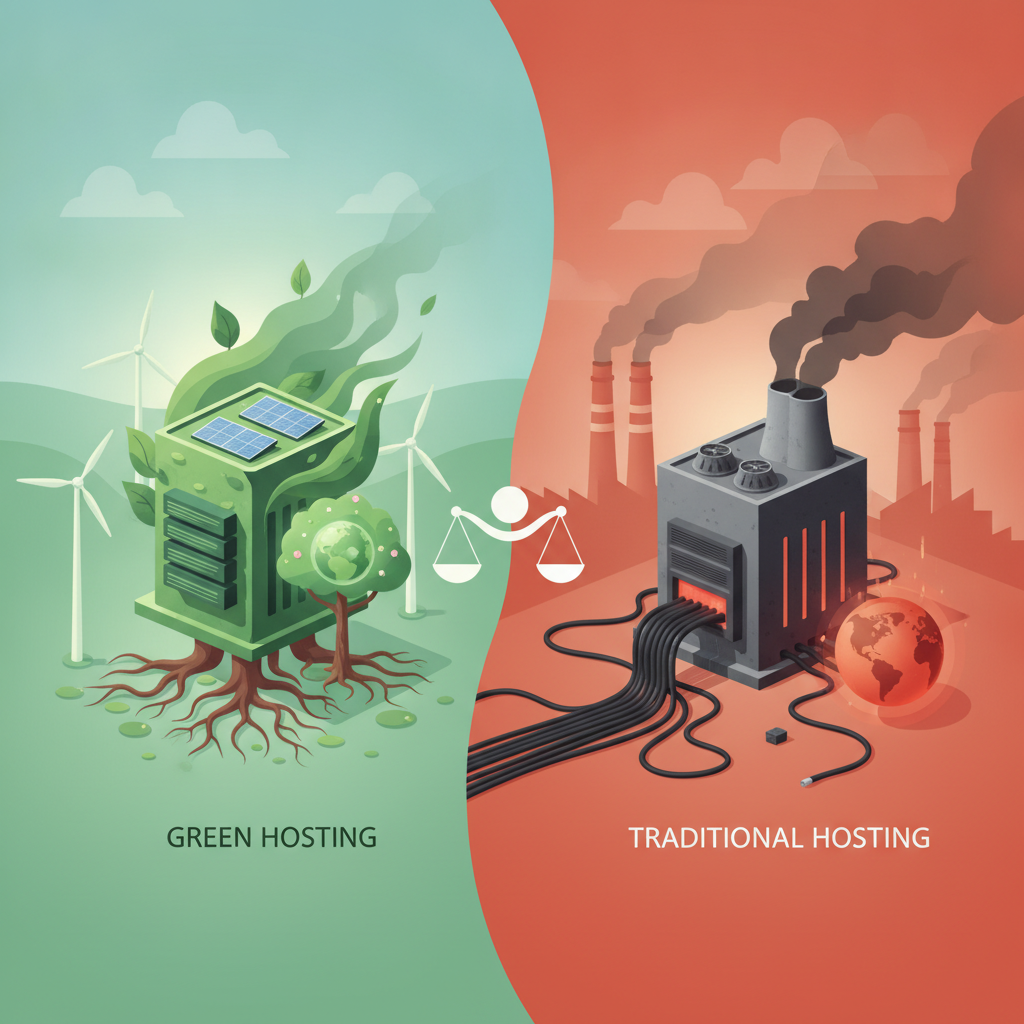
Traditional hosting often relies on fossil-fuel-powered data centers with older, less efficient hardware. Green hosts, by contrast, invest in modern infrastructure. That means you get better performance without paying a premium. Some providers report up to 20% energy cost savings through efficiency gains, which can translate into lower prices for you.
For startups and e-commerce sites — 360Locker’s core audience — green hosting is a low-cost way to demonstrate corporate responsibility from day one. It builds trust with customers and differentiates your brand in a crowded market.
How to Optimize Your Website for Eco-Friendliness Beyond Hosting
Green hosting neutralizes your server’s energy source, but your website’s design also affects its carbon footprint. The heavier your pages, the more energy they consume during loading and data transfer.
Here are practical optimizations that cut energy use:
- Compress images and use lazy loading. Images account for most of a page’s weight. Lazy loading defers off-screen images until a user scrolls to them.
- Choose a lightweight theme. Bloated themes with heavy scripts waste energy. Minimalist designs load faster and use less power.
- Minify CSS and JavaScript. Removing unnecessary characters reduces file size and processing time.
- Enable text compression. Use Gzip or Brotli compression on your server to shrink HTML, CSS, and JavaScript files before they’re sent to the browser, cutting data transfer and energy use.
- Deploy a Content Delivery Network (CDN). CDNs cache your site on servers closer to visitors, cutting data travel distance and server load.
- Enable caching. Cached pages don’t need to be rebuilt on every visit, reducing server processing substantially.
Pairing these strategies with green hosting can cut your site’s per-visit energy consumption by 60–80%.
The Future of Green Hosting: Trends and Innovations to Watch in 2025
Green hosting is evolving rapidly, and 2025 brings several innovations that will make eco-friendly hosting even more effective and affordable. These trends are worth watching when you choose a provider.
- Edge computing and decentralized hosting: Bringing data closer to users reduces the distance data travels, cutting energy consumption significantly.
- AI-driven energy optimization: Smart systems can balance server loads automatically, cutting waste by up to 30% in modern data centers.
- Blockchain-based carbon tracking: Transparent, verifiable offset records will eliminate “greenwashing” concerns and let customers verify claims.
- Liquid cooling and waste-heat recycling: New cooling methods are more efficient than traditional air conditioning, and captured heat is being reused for nearby buildings.
These advances mean that green hosting will only get cheaper, faster, and more reliable. According to industry analysts, sustainability is no longer a niche feature — it’s becoming the default expectation for web infrastructure in 2025.
Frequently Asked Questions About Green Hosting
Is GreenGeeks hosting good?
Yes, GreenGeeks is widely considered a top green hosting provider. They purchase 300% renewable energy credits, offer competitive pricing starting at $2.95/month, and consistently receive positive reviews for uptime, speed, and customer support.
What is the cheapest green hosting?
HostPapa and GreenGeeks both offer plans starting at $2.95 per month, making them among the most affordable green hosts. These plans include free domain registration and SSL certificates, giving you excellent value for an eco-friendly web presence.
How much does one year of green hosting cost?
Depending on the provider and plan, a year of green hosting typically costs between $35 and $120. Basic shared hosting plans from providers like HostPapa and GreenGeeks start at around $35–$40 per year with promotional pricing, while premium managed WordPress hosting may reach $100–$120 annually.
When you combine a green host with a performance-focused provider like 360Locker — which offers 99.95% uptime, OWASP-aligned security reviews, and free migrations — you get an eco-friendly, secure, and fast foundation for your online presence. That’s the winning combination for startups and e-commerce businesses looking to grow responsibly this year.
Key takeaways
- Green hosting relies on renewable energy sources like wind and solar, often via RECs or power purchase agreements.
- It can cut a website's monthly CO2 emissions from ~5.5 kg to near zero.
- Eco-friendly hosting aligns with consumer preference for sustainable brands and can improve brand image.
- Top providers in 2026 include GreenGeeks, A2 Hosting, SiteGround, HostPapa, and DreamHost.
- Green hosting is not necessarily more expensive, and can even save energy costs through efficiency.