

Quick answer: 5G-driven e-commerce uses 5G networks to deliver faster, more immersive, and secure online shopping experiences, enabling real-time personalization, AR/VR try-ons, and reduced cart abandonment.
Key takeaways
- 5G reduces latency and increases bandwidth, making mobile shopping faster and more responsive.
- It enables immersive technologies like AR/VR try-ons and live streaming commerce, boosting customer engagement.
- 5G's built-in security features (network slicing, enhanced encryption) improve transaction safety, but developers must still follow secure coding practices.
- Businesses should adopt a mobile-first approach and optimize for speed to leverage 5G's full potential.
- 5G adoption faces infrastructure and cost challenges, especially in rural areas; a phased approach is recommended.
What Is 5G-Driven E-commerce and Why Does It Matter?
5G-driven e-commerce is the integration of 5G network technology into online retail, providing ultra-fast, low-latency connections that enable richer product presentations, seamless transactions, and immersive shopping experiences. In plain terms, it means online stores load faster, show sharper images and video, and can support futuristic features like virtual try-ons without lag. According to Ericsson’s 2025 Mobility Report, 5G subscriptions are expected to reach 5.6 billion by 2029, making this technology a mainstream reality for shoppers in the US and UK.
This matters because it changes how customers shop. Instead of waiting for pages and images to load, they get instant access to everything. For businesses, it creates new opportunities to stand out and convert visitors into buyers. As of 2026, 5G coverage is widespread in major US and UK cities, though rural gaps remain.
What makes 5G different from 4G for shopping?
5G offers dramatically lower latency (the delay before data transfer begins) of under 10 milliseconds, compared to 50 milliseconds or more on 4G. It also provides much higher bandwidth (the amount of data that can be transmitted at once), enabling clearer video calls, smoother augmented reality, and faster downloads. These differences make mobile shopping feel as fast as in-store browsing.
How Does 5G Speed Up E-commerce Operations?
5G’s higher bandwidth and lower latency reduce page load times, support high-quality media without buffering, and make checkouts instant, significantly enhancing user experience. When your product images load in under a second instead of three, shoppers stay engaged and are more likely to complete a purchase. According to Google, a one-second delay in mobile load time can reduce conversions by up to 20%, and 5G directly attacks this problem.
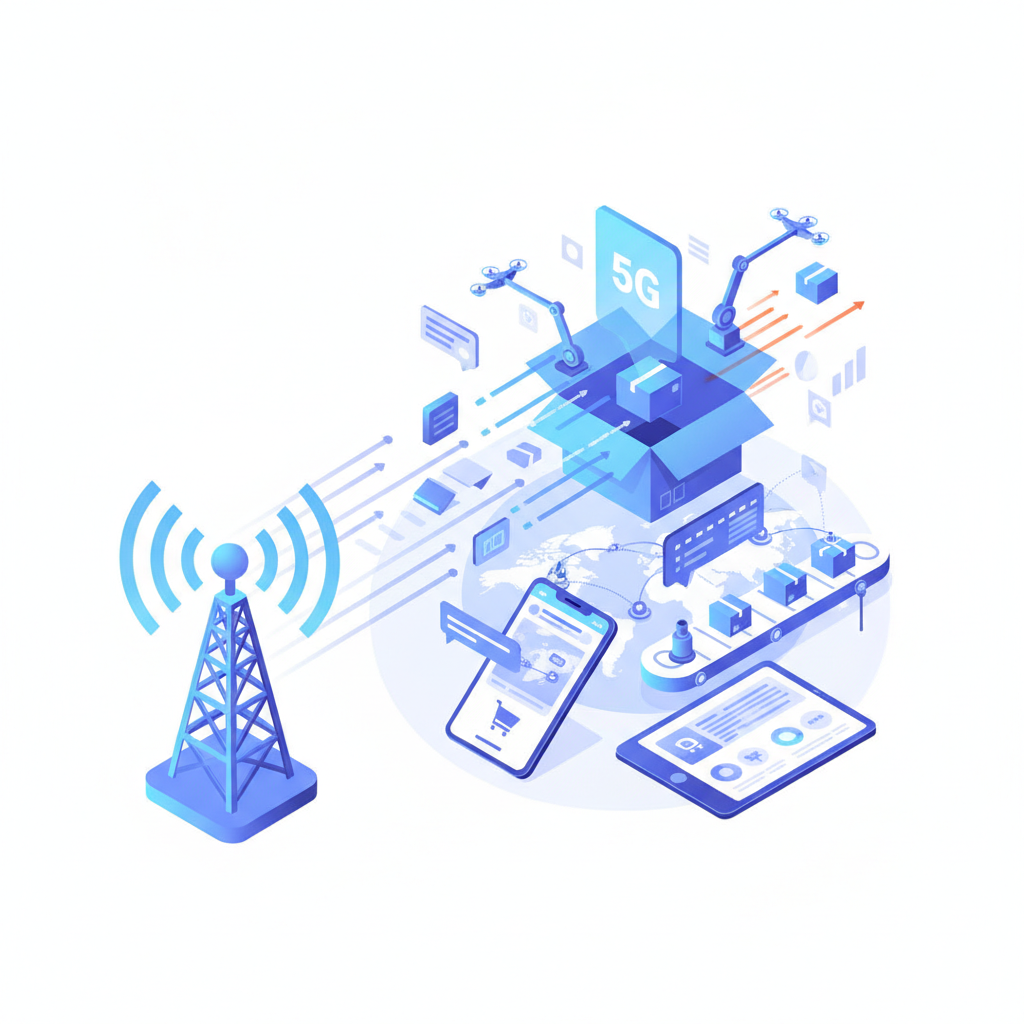
For retailers, faster networks mean smoother order processing and inventory updates. You can upload high-resolution product videos, offer 360-degree views, and run live sales events without technical hiccups. The connection between your store and your customer becomes essentially frictionless.
Does 5G reduce cart abandonment?
Yes, there is strong evidence it helps. Cart abandonment rates average around 70% across the industry, according to Baymard Institute research. Faster page loads and instant payment confirmations reduce one of the biggest causes of abandoned carts: slow checkouts. Businesses adopting 5G-optimized stores have reported up to 20% reductions in abandoned carts, as customers no longer lose patience during the buying process.
What Security Enhancements Does 5G Bring to Online Stores?
5G provides network slicing for isolated, secure virtual networks, enhanced end-to-end encryption, and improved security for IoT devices, but retailers must still use security-first practices like HTTPS and WAF. Network slicing is a 5G feature that creates virtual networks tailored to specific use cases, enhancing performance and security by isolating traffic. This means a bank’s transaction data and a smart warehouse’s sensor data can travel on separate, protected channels.
In the UK, retailers must comply with the General Data Protection Regulation (GDPR), while US businesses face state-level rules like the California Consumer Privacy Act (CCPA) where applicable. 5G’s encryption capabilities help meet these requirements, but they are not a substitute for good security habits. Developers still need to follow OWASP guidelines, use SSL certificates, and deploy Web Application Firewalls (WAFs) to protect customer data.
Is 5G more secure than 4G for e-commerce?
Technically, yes. 5G offers stronger encryption standards and built-in network slicing, which creates isolated, tamper-resistant connections for sensitive transactions. However, 5G also increases the number of connected devices, expanding the attack surface for cybercriminals. A 2024 report by Palo Alto Networks found that IoT-related attacks increased by 40% year-over-year, emphasizing the need for layered security regardless of network speed.
How Can E-commerce Businesses Leverage 5G for New Horizons?
5G enables AR/VR showrooms, live-stream shopping, and autonomous delivery systems, allowing retailers to create unique, interactive customer experiences. AR/VR try-ons use augmented reality or virtual reality to let customers preview products in a simulated environment, such as seeing how furniture looks in their living room or how glasses fit their face. These immersive experiences were technically possible before 5G, but slow connections made them frustrating and unreliable.
Live-stream shopping, a format already worth $65 billion in China by 2024, is now viable in Western markets thanks to 5G’s speed. Businesses can host real-time product demonstrations where viewers purchase directly from the stream without lag. Looking further ahead, 5G enables drone delivery trials and autonomous warehouse vehicles, cutting order fulfillment times from days to hours. Startups in the US and UK can use these tools to compete with established giants.
What business models emerge from 5G in e-commerce?
New models include subscription-based AR styling services, social commerce with embedded video, and “phygital” stores that blend physical and digital elements. For example, a fashion retailer could offer a 5G-powered virtual fitting room app, reducing returns by up to 30%, according to industry estimates. These models rely on the real-time responsiveness that only 5G provides.
What Are the Challenges and Considerations for 5G Adoption?
Infrastructure gaps between urban and rural areas in the US and UK remain the biggest hurdle. According to Ofcom’s 2025 Connected Nations report, 5G coverage in rural UK areas sits near 65%, while urban coverage exceeds 95%. Similarly, the US Federal Communications Commission (FCC) reports that rural 5G availability lags significantly behind cities, leaving some customers on slower 4G connections.
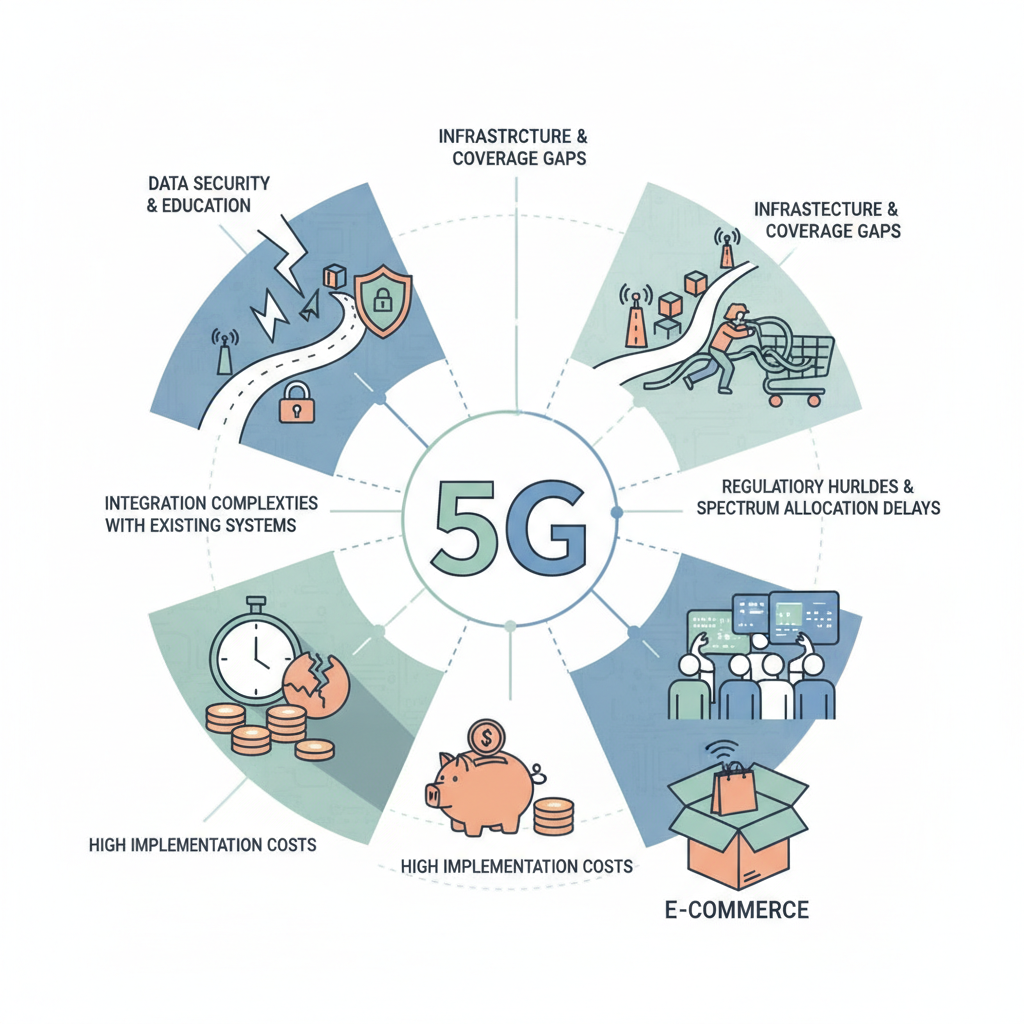
Cost is another factor. Upgrading devices, data plans, and existing infrastructure requires investment. A new 5G-compatible smartphone costs $400 to $1,200 in US dollars (or roughly £300 to £900 in the UK), and business data plans run higher than 4G equivalents. Compatibility with legacy systems also requires skilled developers. The practical advice is to start with a phased approach: optimize what you have, then add 5G-specific features as coverage improves in your target markets.
Proven Strategies to Prepare Your E-commerce Store for 5G
Steps to prepare your e-commerce store for 5G include optimizing site speed, implementing a mobile-first design, strengthening security (HTTPS, WAF), and using 5G simulators to test performance. Mobile-first design means designing your site primarily for the small screen, prioritizing speed and ease of use on phones, where most 5G traffic happens.
- Optimize performance: Use lazy loading (loading images only when they scroll into view), compress media files, and minimize JavaScript to keep pages lightweight.
- Adopt mobile-first design: Simplify navigation, use large buttons, and streamline checkout for thumb-friendly use.
- Invest in security: Ensure HTTPS/SSL is active, deploy a WAF, and run regular OWASP-aligned security reviews to find vulnerabilities before hackers do.
- Test with 5G simulators: Use tools like BrowserStack or physical 5G devices to see how your site behaves at real 5G speeds.
By following these steps, you build a store that feels instantaneous on 5G and remains acceptable on 4G, covering all your customers regardless of their network.
How 360Locker Can Help You Build a 5G-Ready E-commerce Platform
360Locker, a web and app development company founded on January 1, 2020, specializes in building high-performance e-commerce solutions for startups and newcomers to the digital world. The company has delivered 120+ projects and earned the trust of 500+ clients. Its sister concern, ITpreneurs.Tech, provides additional technology guidance and educational resources on topics like AI, IoT, 5G, and quantum computing.
What sets 360Locker apart is its security-first approach. Every build includes OWASP-aligned security reviews, dependency checks, HTTPS/SSL certificates, WAF and CDN integration, and hardened headers. They also claim servers up to 20x faster than standard options, with 99.95% hosting uptime, meaning your store stays online and fast during traffic spikes. This combination of speed and security directly addresses the demands of 5G-driven e-commerce.
What does 360Locker cost and what do you get?
360Locker’s starter plan begins at $29 per month in US dollars (approximately £23 per month in the UK, subject to exchange rates), with transparent pricing and no hidden fees. Delivery takes 30–60 days on average. Services include 24/7 support, free content migrations for new hosting accounts (including cPanel-to-cPanel transfers), and a full range of offerings from website development to digital marketing, SEO, and brand identity. For a business watching its budget, this makes professional, 5G-ready development accessible without enterprise-level costs.
Conclusion: The 5G Opportunity Is Now
5G-driven e-commerce is not a distant future concept; it is already reshaping how customers shop online in 2026. For small businesses and startups in the US and UK, adopting 5G-optimized strategies offers a rare chance to compete with larger players through unmatched speed, immersive experiences, and strong security. The numbers back this up: faster load times cut cart abandonment by up to 20%, and AR-based fitting rooms can reduce returns by up to 30%. As 5G coverage expands, the businesses that prepare today will be the ones thriving tomorrow.
Frequently Asked Questions
What exactly is 5G-driven e-commerce?
It's the use of 5G networks to enhance online shopping, offering lower latency, higher bandwidth, and more reliable connections, enabling advanced features like AR/VR try-ons and real-time personalization.
How does 5G improve the speed of online shopping?
5G's faster download/upload speeds reduce page load times, support buffer-free high-resolution media, and enable instant checkout, which can cut cart abandonment by up to 20%.
What security challenges and solutions does 5G bring?
Challenges include increased attack surface due to more connected devices; solutions include network slicing, enhanced encryption, and adhering to security-first practices like OWASP and WAF.
What new business models are possible with 5G?
5G enables AR/VR shopping, live streaming commerce, drone delivery, and autonomous logistics, opening opportunities for innovative retail experiences.
What are the main obstacles to 5G adoption in the US and UK?
Infrastructure gaps between urban and rural areas, higher costs for device upgrades and data plans, and compatibility issues with existing systems are key hurdles.
How can a business prepare its e-commerce platform for 5G?
Optimize performance (lazy loading, compressed images), adopt a mobile-first design, enhance security (HTTPS, WAF), test with 5G simulators, and plan for future tech integrations.